

BWP stands for Boiling Waterproof, and it’s one of the most searched plywood terms precisely because the abbreviation itself explains almost nothing. Knowing the full form doesn’t tell you what makes a board boiling waterproof, how that’s actually tested, or how to tell a genuine BWP board from one wearing the label loosely. This guide covers all three.
BWP plywood full form is Boiling Waterproof plywood, a grade defined by its ability to withstand prolonged and repeated exposure to water without the bonded layers separating. Unlike MR grade, which is built for occasional dampness, BWP is engineered specifically for environments where water exposure is a regular, ongoing fact of life: kitchens, bathroom-adjacent cabinetry, and humid coastal climates.
The meaning of BWP plywood, in practical terms, comes down to the adhesive resin used to bond the veneer layers. A phenolic-type bonding system is what allows the board to survive conditions that would cause a standard MR-grade board to delaminate within a season.
This is the part most dealers skip over, and it’s the part worth understanding before you pay a premium for the grade. A genuine BWP-grade board is verified by immersing a sample in boiling water for a set duration and then checking whether the adhesive bond between the veneer layers has held. If the layers separate, delaminate, or show visible gaps under that test, the board fails the grade regardless of what the invoice says.
Oswin’s BWP line, marketed as Oswin Ply Platinum, cites a 108-hour boiling-water benchmark as its testing standard, a specific, stated duration rather than a vague marketing claim. The reason this kind of specificity matters is simple: a testable claim can be verified; a generic “waterproof” claim on a label cannot.
| Factor | MR plywood | BWP plywood |
|---|---|---|
| Moisture handling | Occasional dampness only | Prolonged, repeated exposure |
| Bonding resin | Urea-formaldehyde type, lower water tolerance | Phenolic-type, built for sustained moisture |
| Typical cost | Lower | Higher, reflects the bonding system |
| Best for | Dry interior furniture, wardrobes | Kitchens, bathroom-adjacent furniture, humid regions |
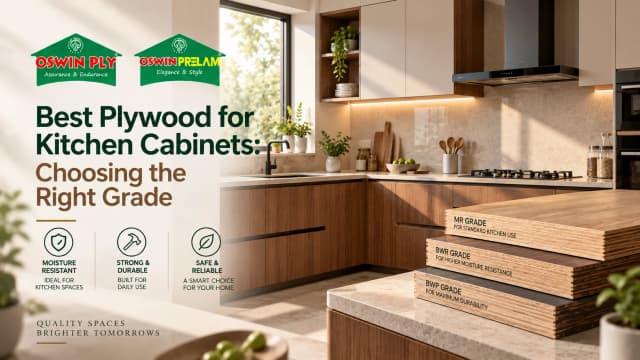
Neither grade is universally “better”; they’re built for different jobs. Using BWP everywhere adds cost without adding benefit in a dry bedroom. Using MR in a kitchen is the mistake that shows up as swollen, peeling cabinetry a year or two later. For the complete grade comparison including HMR and marine grade, see our full guide to Plywood Grades, Types and Uses.
BWP is one of the more misunderstood grades in everyday shopping conversations, partly because the name itself sounds like an absolute guarantee rather than a specific, tested performance level.
Not accurate. BWP grade means the bonded layers survive prolonged, repeated exposure and pass a boiling-water test on the adhesive bond specifically. It’s a meaningfully higher moisture tolerance than MR grade, not an unconditional guarantee against every possible water condition indefinitely. For genuinely continuous, sustained water contact, marine grade is the more appropriate specification.
Two boards can both be sold as BWP grade and still perform differently in practice, since the specific resin formulation, veneer quality, and manufacturing consistency all affect real-world performance beyond the baseline grade classification. This is exactly why asking for a specific, stated test standard, rather than accepting the grade name alone, matters.
“Waterproof” is often used loosely by sellers to describe several different grades. BWP is a specific, testable classification; “waterproof” on its own is not. Always ask which grade a board marketed simply as “waterproof” actually refers to.
BWP and marine grade are often confused, since both sit at the higher-moisture end of the grading scale, but they’re built for different intensities of exposure. BWP is designed for prolonged, repeated moisture, the kind a kitchen or bathroom-adjacent cabinet genuinely experiences day to day. Marine grade goes a step further, built for continuous, sustained water contact, which is a meaningfully different and more demanding condition.
For most kitchen and bathroom cabinetry, BWP grade is the right, cost-effective specification. Marine grade becomes worth the additional cost specifically for kitchen sink base units, exterior-facing furniture, or any application with genuinely continuous water exposure rather than repeated but intermittent contact.
BWP stands for Boiling Waterproof. It refers to a plywood grade bonded to survive prolonged, repeated water exposure, verified through a boiling-water test on the adhesive bond between layers.
BWP plywood is built for sustained moisture resistance, not permanent, unconditional waterproofing under every possible condition. It’s a significant step up from MR grade, but it’s still wood, and proper installation and maintenance still matter.
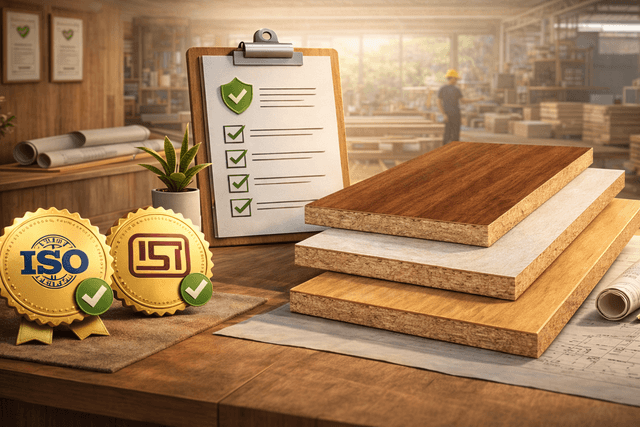
Check for the ISI mark on the board itself, ask the dealer for the specific certified standard, and where possible, ask about the boiling-test duration the manufacturer states for that product line.
No. Marine grade is a higher specification than BWP, built for continuous rather than repeated water exposure. BWP is suitable for kitchens and humid interiors; marine grade is the choice for sustained water contact.
BWP plywood earns its higher price when it’s genuinely tested to the standard it claims, and the boiling-water test is exactly the kind of verifiable process that separates a real grade from a marketing label. Know the full form, understand what the test actually checks, and ask your dealer for specifics rather than accepting the abbreviation as proof on its own.
Oswin Wood Panels manufactures ISI-certified BWP plywood (Oswin Ply Platinum), marine plywood and block board from Chennai. Our team can help match the right grade to your kitchen, bathroom or coastal-home project.
Call 044 2669 0023 or find your nearest Oswin dealer.
Written by Mr. Balakrishna Iyer, GM – Sales (Tamil Nadu), Oswin Ply (Oswin Wood Panels Pvt. Ltd), a Chennai-based plywood and block board manufacturer. We manufacture ISI-certified BWP plywood, marine plywood, flush doors, block boards and Prelam boards, including HDHMR-core options, supplying dealers across Tamil Nadu, Karnataka, Andhra Pradesh, Telangana, Maharashtra and Goa.