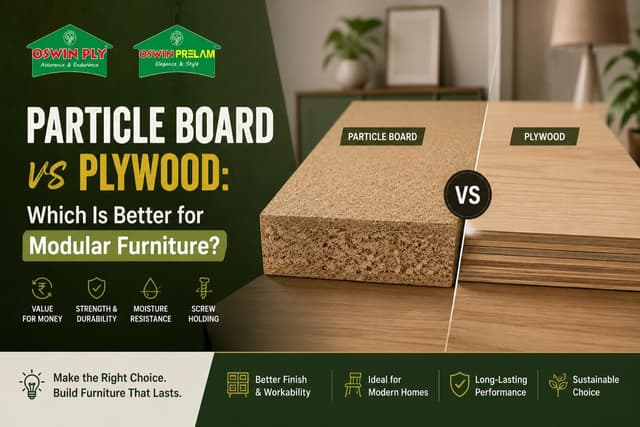


Engineered wood vs plywood is a comparison that trips people up before it even starts, because technically, plywood is a type of engineered wood. In everyday furniture shopping, though, the term “engineered wood” almost always refers to something more specific, composite boards like particle board, MDF, and HDHMR, as distinct from plywood. That’s the comparison most buyers actually mean when they search this term, and it’s worth clarifying before comparing anything else.
In common furniture marketing, engineered wood refers to composite boards manufactured by compressing wood particles, fibers, or strands together with resin, rather than layering solid wood veneers. Particle board, MDF, and HDHMR/HMR all fall under this everyday usage of the term. Each has a slightly different manufacturing process and density, but they share the same basic idea: reconstituted wood material rather than layered natural veneer.
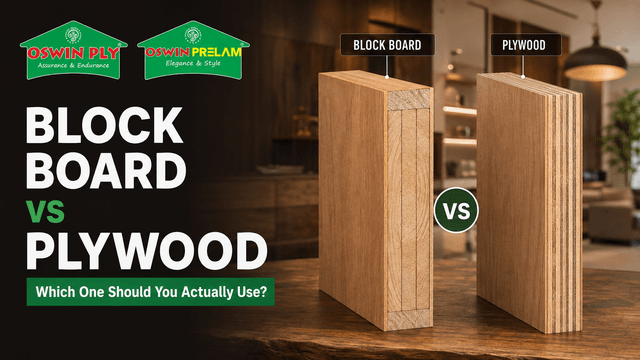
Plywood, by contrast, is built from thin layers of real wood veneer glued together with each layer’s grain running perpendicular to the one below it. That cross-grain construction is what gives plywood its particular strength profile, good load-bearing capacity and screw-holding strength across the whole panel, not just at the surface. For the full breakdown of plywood grades and types, see our complete guide to Plywood Grades, Types and Uses.
| Factor | Engineered wood (composite) | Plywood |
|---|---|---|
| Strength | Good for flat panels, weaker at screw-holding edges | Strong across the panel, holds screws and joints well |
| Moisture resistance | Varies widely, generally lower unless specifically treated | Grade-dependent, MR to marine covers a wide range |
| Weight | Generally heavier for the same panel size | Comparatively lighter for equivalent strength |
| Cost | Generally lower | Generally higher, reflects the veneer-layering process |
| Finish flexibility | Wide range of laminate and veneer finishes | Fewer decorative options, more structural focus |
| Typical application | Modular furniture, laminate-finished cabinetry | Load-bearing furniture, wardrobes, kitchens |
Composite boards are a genuinely sound choice for budget-conscious modular furniture where a wide range of laminate or veneer finishes matters, and where the panel isn’t carrying serious structural load. Wardrobe shutters, cabinet fronts, and decorative panels are all reasonable applications. Oswin’s own Prelam Particle Board line is built specifically for this segment, and our Particle Board vs Plywood guide covers this comparison in more depth.
Anywhere load-bearing capacity, moisture resistance, or long-term durability matters more than upfront cost, plywood generally outperforms composite alternatives. Wardrobe carcasses, kitchen cabinetry, and any furniture that will see repeated stress or occasional dampness are better served by plywood at the appropriate grade. This isn’t a case for choosing plywood over engineered wood in every situation; it’s a case for matching the material to the actual demands of the application.
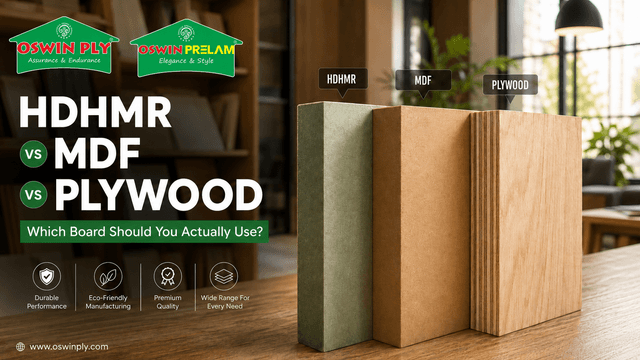
HDHMR (High Density High Moisture Resistant) sits at the higher-performance end of the engineered wood category, denser and more moisture-resistant than standard MDF or particle board, though still a different manufacturing process from plywood. It’s frequently compared directly against both MDF and plywood when buyers are specifying modular kitchens or wardrobes. For that specific three-way comparison, see our HDHMR vs MDF vs Plywood guide.
Some furniture types don’t fall neatly into either category, and it’s worth addressing these directly rather than leaving the decision vague.
These carry moderate, fairly static weight and are almost always visible, making them a genuine toss-up. Engineered wood with a quality laminate finish works well here, since the load is manageable and the finish variety helps the piece match the room. Plywood is worth the upgrade only if the unit will carry unusually heavy equipment or see frequent rearranging.
Desks see repeated, direct pressure from writing, typing, and daily use in a way that tests screw-holding strength at the joints more than most furniture. Plywood at MR grade or above is the more durable choice here, even though it costs more upfront, since desk joints are exactly where particle board tends to loosen first.
Load-bearing shelving, particularly for books, is one of the clearest cases for plywood over engineered wood. Sustained weight across a shelf span is precisely the condition composite boards handle worst, sagging noticeably over months where plywood holds its shape.
Engineered wood, since it’s manufactured from reconstituted wood particles and fibers, can make more efficient use of smaller wood offcuts and lower-grade timber that wouldn’t be suitable for veneer production. Plywood, requiring intact, higher-quality logs for veneer peeling, generally demands more consistent, higher-grade raw material. This is worth factoring in if sourcing efficiency matters to your project, though it doesn’t override the performance differences covered above for structural applications.
Upfront price is only part of the real cost comparison. Engineered wood’s lower purchase price can be offset, sometimes significantly, by a shorter effective lifespan in demanding applications, particularly anywhere moisture or sustained load is involved. A wardrobe carcass built from plywood at the correct grade may cost more initially but avoid a full replacement five years later that an under-specified composite alternative would require. For furniture expected to last a decade or more in active daily use, factoring in this replacement cycle, not just the sticker price, gives a more honest comparison.
Not in everyday usage. While plywood is technically a category of engineered wood, the term “engineered wood” in furniture shopping usually refers specifically to composite boards like particle board, MDF, and HDHMR, as distinct from layered veneer plywood.
Properly graded plywood generally lasts longer under load and moisture exposure than standard composite engineered wood, though a well-specified engineered wood product in the right application can perform reliably for years.
Generally, yes. Composite engineered wood boards typically cost less than plywood of comparable size, though the price gap narrows for higher-grade, moisture-resistant plywood.
Standard engineered wood has limited moisture tolerance and can swell or degrade with sustained water exposure. For wet-prone areas, BWP or marine-grade plywood is the more reliable choice.
Engineered wood vs plywood isn’t a competition with one universal winner; it’s a decision that depends on what the furniture needs to do. Composite engineered wood earns its place in budget, finish-flexible modular projects, while plywood at the right grade remains the stronger choice anywhere load and moisture are genuine concerns. Understanding the real difference between the two, rather than treating them as interchangeable, is what actually protects the investment.
Oswin Wood Panels manufactures both sides of this comparison from Chennai, ISI-certified plywood (MR to marine grade) and Prelam Particle Board, so we can help you mix structural and decorative materials sensibly across a whole-home project.
Call 044 2669 0023 or find your nearest Oswin dealer.
Written by Mr. Balakrishna Iyer, GM – Sales (Tamil Nadu), Oswin Ply (Oswin Wood Panels Pvt. Ltd), a Chennai-based plywood and block board manufacturer. We manufacture ISI-certified BWP plywood, marine plywood, flush doors, block boards and Prelam boards, including HDHMR-core options, supplying dealers across Tamil Nadu, Karnataka, Andhra Pradesh, Telangana, Maharashtra and Goa.