

Ask a dealer for termite-proof plywood, and you will be handed something. Ask what makes it termite-proof, and the answer gets vague. That vagueness is worth understanding, because it is where most of the money in this category is wasted.
Start here, because it changes how you shop. Plywood is wood. Termites eat wood. No wood-based panel can be made permanently, absolutely immune to termite attack, and no Indian Standard certifies a board as “termite proof.”
What manufacturers can genuinely do is make a board hostile to termites — treated, dense, and chemically unattractive — so that under normal conditions it is not attacked. That is termite resistance, and it is a real, measurable, worthwhile property.
So when a board is marketed as termite proof, the honest reading is “termite resistant, marketed confidently.” That is not a reason to dismiss it. It is a reason to ask what the resistance is actually built on, because the answer varies enormously between boards that look identical.
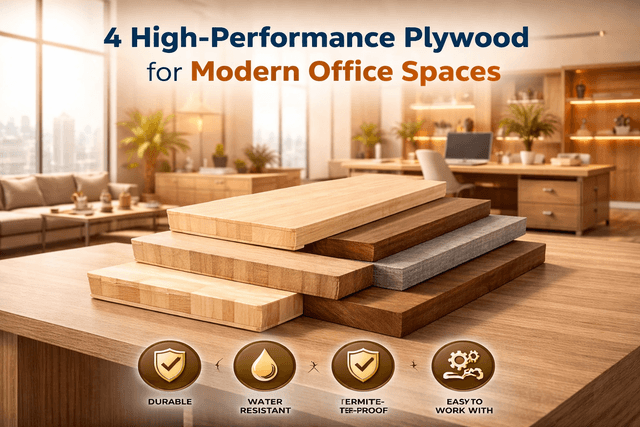
1. Preservative treatment of the veneers. This is the main mechanism. Veneers are treated with wood preservatives before assembly, so protection sits throughout the thickness rather than on the surface. This matters because the moment you cut a sheet, any surface-only treatment is breached, but a board treated at the veneer stage is protected on the new cut face too.
2. Timber density. Denser hardwood is simply harder to attack. Oswin Ply Club is made from 100% Gurjan (Dipterocarpus), a dense hardwood, and density here does double duty: it resists termites and holds screws better.
3. The resin and bonding system. Cured phenolic resin is not food. A board where the bond runs deep through the layers has less untreated wood available. Oswin’s ARTechnology® is built around deep-dive impregnation, calibrated compression and thermal polymerisation, which the company positions as forming a bond through the board’s thickness rather than adhering layers at the surface, contributing to termite protection as well as moisture resistance.
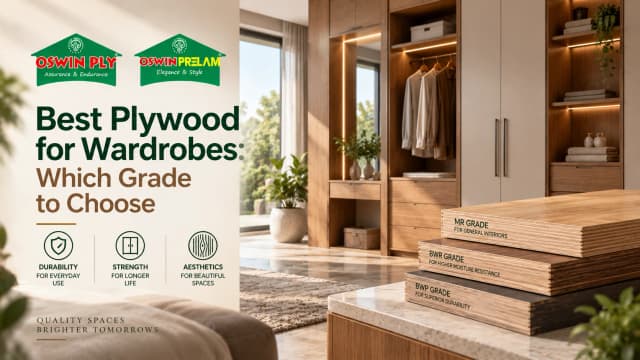
4. Moisture resistance, which is inseparable from the rest. Termites need moisture. A board that stays dry is a board that is far less likely to be attacked, which is why higher moisture grades and termite resistance tend to arrive together. It also explains a common confusion: BWP grade certifies water resistance, not termite resistance. They correlate strongly. They are not the same certification.
Oswin’s stated position on this is that protection works by reinforcing the wood at a cellular level against termites, borers, fungus, and moisture-related damage — the four typically arriving together rather than separately.
Termite pressure is not uniform across the country. Warm, humid conditions with a long wet season are the favourable case for subterranean termites, and coastal Tamil Nadu, Kerala, coastal Andhra and coastal Karnataka all sit squarely in that band.
For furniture in Chennai, termite resistance is therefore not a premium add-on to consider; it is a baseline specification, in the same way that moisture grade is.
Termites arrive from the ground and travel through moisture. So risk is not evenly spread through a house:
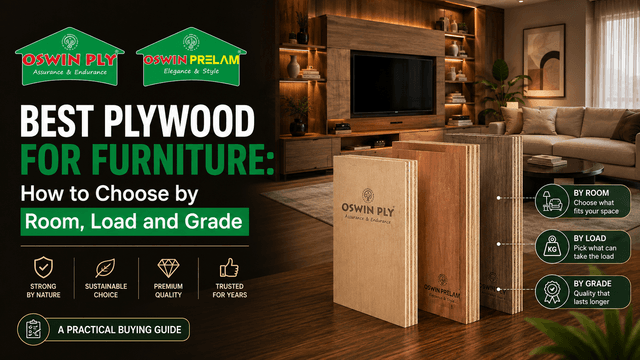
Upper-floor, away-from-wall, dry-room furniture is genuinely lower risk. Specifying marine-grade termite-resistant board for an upstairs study bookshelf is money that would do more work in the kitchen. (Our Best Plywood for Furniture guide maps grade and zone to each room.)
Even the best-treated board fails if the conditions are wrong. Three things do as much work as the specification:
Specification plus detailing plus maintenance. Any one of the three alone is not enough.
No board is termite proof. Good boards are genuinely termite resistant, and that resistance is built from preservative-treated veneers, dense timber, deep resin bonding and moisture performance. Verify the treatment and the certification rather than the marketing words, prioritise ground-floor and wet-zone furniture, and seal every edge you cut.
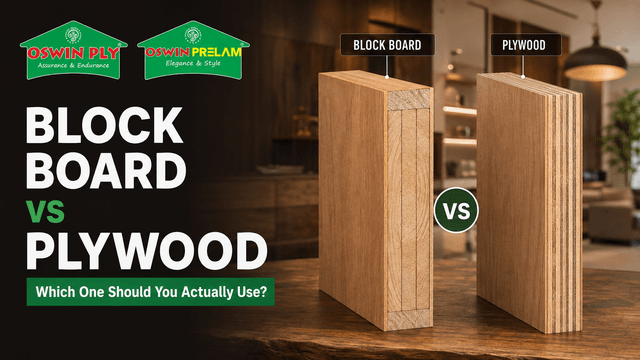
The same treatment and detailing principles apply whether the carcass is plywood or block board — see our Block Board vs Plywood comparison.
Oswin Wood Panels manufactures plywood, block board and doors from Chennai, using preservative-treated timber and its ARTechnology® bonding system, with ISI-certified products across interior to marine grade.
Call 044 2669 0023 or find your nearest Oswin dealer.
Written by Mr. Balakrishna Iyer, GM – Sales (Tamil Nadu), Oswin Ply (Oswin Wood Panels Pvt. Ltd), a Chennai-based plywood and block board manufacturer. We manufacture ISI-certified BWP plywood, marine plywood, flush doors, block boards and Prelam boards, including HDHMR-core options, supplying dealers across Tamil Nadu, Karnataka, Andhra Pradesh, Telangana, Maharashtra and Goa.