

Ask five different dealers what makes one type of plywood better than another, and you will likely get five different answers, most of them centered on price rather than the actual specification that determines whether a board performs. Plywood grades and types are not marketing categories. They describe real, testable differences in how a board is built and what it can survive once it’s inside a piece of furniture or a wall panel. This guide covers what plywood actually is, the grades that matter, and how to match the right type to the job in front of you.
Plywood is an engineered wood panel made by gluing together thin layers of wood veneer, known as plies, with the grain of each layer running perpendicular to the one directly below it. That cross-grain construction is the whole trick. Wood is naturally strong along the grain and weak across it, so stacking layers at right angles cancels out that weakness and gives the finished panel roughly equal strength in every direction. A solid plank of the same thickness would warp, split, or expand unevenly with humidity in a way a well-made plywood sheet resists.
The number of plies matters too. More layers, for a given overall thickness, generally means a more balanced and dimensionally stable board, since the stresses are distributed across more cross-grain junctions rather than concentrated in a few thick layers.
The grade is the single most important thing to check before buying, because it tells you how the board will behave around moisture, and moisture is what kills furniture.
| Grade | Full meaning | Moisture resistance | Typical use |
|---|---|---|---|
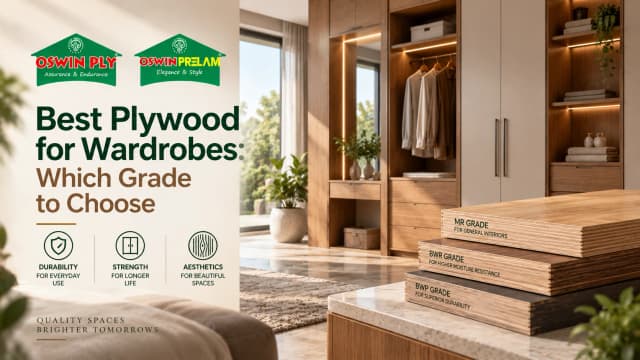
| MR | Moisture Resistant | Occasional dampness, not standing water | Dry interior furniture, wardrobes, general cabinetry |
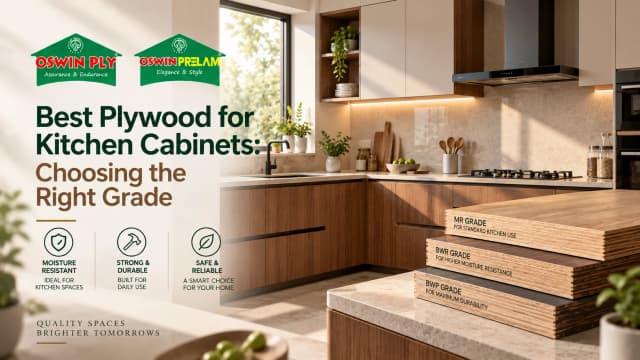
| BWP | Boiling Waterproof | Prolonged, repeated moisture exposure | Kitchens, bathroom-adjacent furniture, humid climates |
| BWR | Boiling Water Resistant (varies by seller) | Marketed between MR and BWP, inconsistent definitions | Verify by ISI mark before buying, not the label alone |
| HMR | High Moisture Resistant | Above standard MR, below full BWP | Semi-wet utility areas where full BWP isn’t required |
| Marine | Highest waterproof specification | Continuous, sustained water contact | Kitchen sink zones, exterior-facing furniture |
MR is the workhorse grade for dry interior furniture. It handles the occasional splash or ambient humidity without issue, but it was never engineered for sustained water exposure. This is the most common grade used in bedroom wardrobes, general shelving, and cabinetry that stays away from water. Using MR-grade board in a genuinely wet zone, under a kitchen sink for instance, is one of the most common and most expensive mistakes buyers make, because the failure shows up months later, not on the day of purchase.
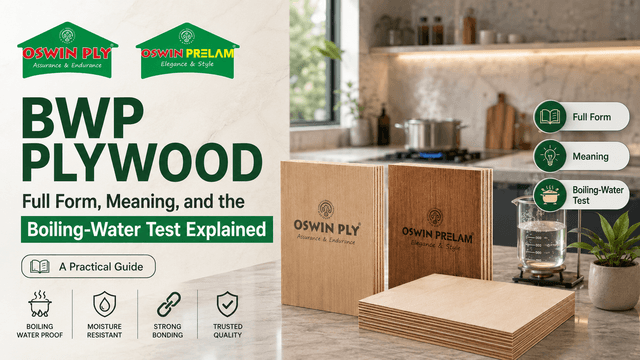
BWP plywood is bonded with a resin system built to survive prolonged moisture without the layers separating. Manufacturers typically verify this with a boiling-water test, immersing a sample for a set duration and checking that the bond holds. It’s the standard, sensible default for kitchens and any furniture that sits near a consistent water source.
BWR is one of the least consistently defined terms in the Indian plywood market. Some dealers use it interchangeably with BWP. Others position it as an intermediate grade sitting between MR and full BWP performance, with no universal standard enforcing which meaning applies where you’re shopping. The practical rule: don’t buy based on the term BWR alone. Ask for the specific ISI-certified grade the board is tested against.
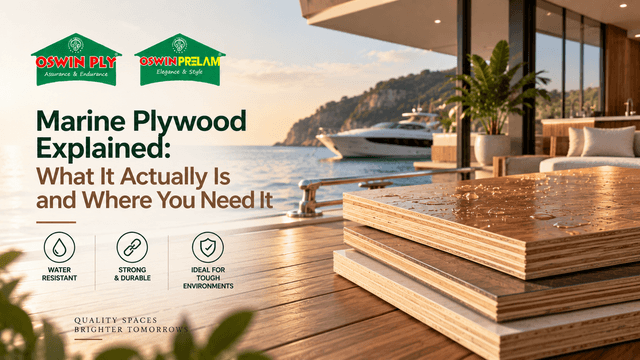
Marine grade is the top of the moisture-resistance ladder, built for continuous water contact rather than occasional or repeated exposure. This is the right specification for kitchen sink base units specifically, and for any exterior-facing furniture application. A board built to marine specification, like Oswin Ply Club, is worth the added cost precisely because it’s solving a problem the lower grades were never designed to solve.
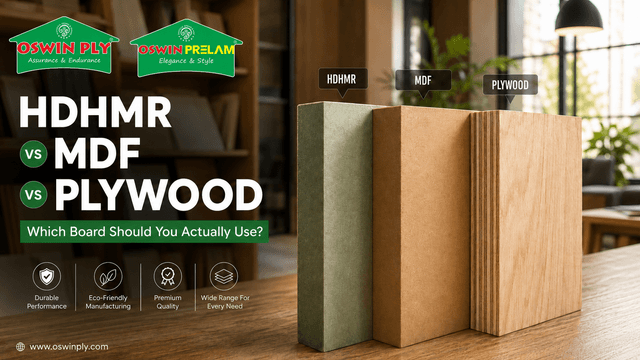
HDHMR (High Density High Moisture Resistant) comes up constantly in the same conversations as plywood grades, but it’s technically a different product category altogether: a high-density engineered board rather than a layered veneer plywood. Buyers frequently weigh it directly against plywood and MDF when specifying modular furniture, which is a genuinely different comparison than choosing between plywood grades. For the full side-by-side, see our HDHMR vs MDF vs Plywood comparison.
Grade tells you how a board survives moisture. Core construction tells you how it carries weight, and that’s a separate decision entirely.
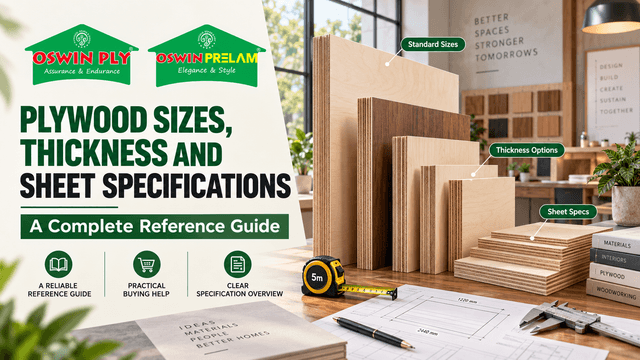
Standard plywood in India is most commonly sold in 8x4 foot sheets, with thickness options ranging from 4mm for cabinet backs up to 19mm and beyond for load-bearing structural work. Getting the thickness right for the application matters as much as getting the grade right.
Match the grade and type to the actual demands of the room and the load, not to habit or to whatever a dealer happens to have in stock. A board that’s over-specified for a dry bedroom wardrobe wastes money. One that’s under-specified for a kitchen cabinet costs far more to replace later than it would have cost to buy the first time correctly.
MR (Moisture Resistant) plywood handles occasional dampness and suits dry interior furniture. BWP (Boiling Waterproof) plywood is bonded to survive prolonged, repeated water exposure and is the standard choice for kitchens and any furniture near a consistent water source.
No. Marine grade is a higher waterproof specification than standard BWP, built for continuous rather than repeated water contact. Both are waterproof grades, but marine plywood is the stronger of the two and costs more accordingly.
Plywood grade refers to the type of adhesive resin used to bond the veneer layers together, which determines how much moisture the board can survive. It has nothing to do with the visual finish or appearance of the board.
Not technically. HDHMR is a high-density engineered board, a different manufacturing process from layered veneer plywood, though the two are frequently compared for the same furniture applications.
Understanding plywood grades and types is not a technical detour before the real decision; it is the real decision. Whether you’re specifying a wardrobe, a kitchen, or a full modular interior, the grade determines how long the furniture actually lasts, and the type of core determines how well it carries load. Use this guide as your starting reference, and follow the links throughout to the deeper, grade-specific guides when you’re ready to specify a particular product.
Oswin Wood Panels manufactures plywood, block board and doors from Chennai, with ISI-certified products across interior to marine grade. Our team can help match grade and type to your drawing.
Call 044 2669 0023 or find your nearest Oswin dealer.
Written by Mr. Balakrishna Iyer, GM – Sales (Tamil Nadu), Oswin Ply (Oswin Wood Panels Pvt. Ltd), a Chennai-based plywood and block board manufacturer. We manufacture ISI-certified BWP plywood, marine plywood, flush doors, block boards and Prelam boards, including HDHMR-core options, supplying dealers across Tamil Nadu, Karnataka, Andhra Pradesh, Telangana, Maharashtra and Goa.