

Particle board vs plywood is one of the most practical comparisons a modular furniture buyer will make, because unlike some plywood debates, this one has a genuinely clear answer once you know what the furniture actually needs to do. The two materials aren’t competing for the same job, and knowing which does what saves both money and future repair headaches.
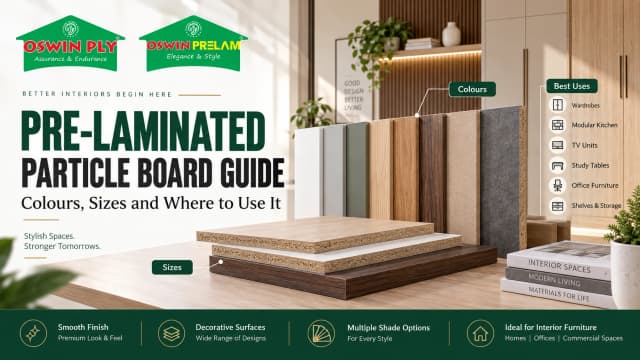
Particle board is manufactured by compressing small wood particles and resin under heat and pressure into a flat panel. It’s a reconstituted wood product rather than a layered one, which makes it lighter to produce and generally less expensive than plywood of the same size. Prelam particle board takes this a step further, arriving pre-laminated with a decorative finish already bonded to the surface, which is why it’s the go-to choice for modular furniture where finish variety matters.
Plywood is built from thin layers of real wood veneer, cross-bonded so each layer’s grain runs perpendicular to the one beneath it. That construction gives plywood stronger load-bearing capacity and better screw-holding strength than particle board, particularly at panel edges and joints, which is exactly where modular furniture tends to fail first if the wrong material is used. Our complete guide to Plywood Grades, Types and Uses covers the full range of grades available.
| Factor | Particle board | Plywood |
|---|---|---|
| Construction | Compressed wood particles and resin | Layered wood veneers, cross-grain bonded |
| Load capacity | Lower, best for lighter, flat applications | Higher, suited to load-bearing furniture |
| Screw-holding strength | Weaker, especially at edges | Stronger, holds fittings and joints reliably |
| Moisture resistance | Lower, swells if exposed to water | Grade-dependent, MR to marine available |
| Finish flexibility | Wide range of laminate finishes, often pre-applied | Fewer decorative options, more structural focus |
| Cost | Lower | Higher |
| Best for | Wardrobe shutters, cabinet fronts, budget modular furniture | Load-bearing carcasses, kitchens, high-use furniture |
For modular furniture where the priority is a wide laminate finish selection at a reasonable cost, and the panel isn’t carrying sustained heavy load, particle board is a genuinely sound choice. Wardrobe shutters, cabinet fronts, and other largely decorative, low-stress panels are exactly where this material earns its lower price. Oswin’s Prelam Particle Board line, available in 100+ laminate finishes, is built specifically for this segment. If you’re also weighing how laminate finish choice interacts with the board underneath it, our Plywood and Laminate Pairing Guide covers kitchen and wardrobe applications in detail.
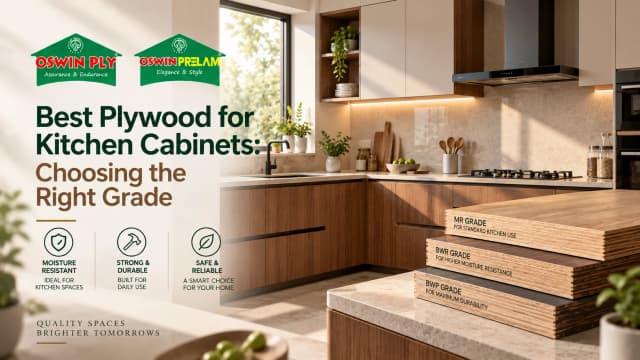
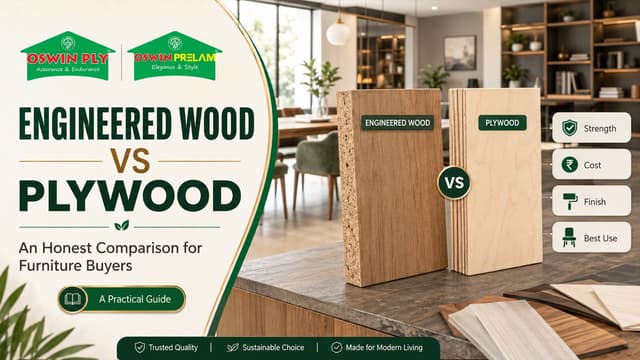
Anywhere the panel will carry real, sustained weight, kitchen cabinet carcasses, wardrobe frames, shelving units, plywood at the appropriate grade holds up better over time. Particle board can sag or lose screw-holding strength under sustained load in a way properly graded plywood simply does not. For kitchens specifically, where moisture is also a factor, BWP or marine-grade plywood is the more reliable structural choice, with particle board reserved for the visible, laminate-finished surfaces. For the wider composite-vs-veneer picture, see our Engineered Wood vs Plywood comparison.
Particle board’s cost advantage over plywood is real but shouldn’t be overstated as the deciding factor on its own. For a given panel size, particle board typically costs meaningfully less than plywood of comparable thickness, and that gap widens further when comparing against higher grades like BWP or marine plywood. On a full modular wardrobe or kitchen project, choosing particle board for the visible, low-stress panels while reserving plywood for structural carcasses can meaningfully reduce total material cost without touching the components where that saving would actually cost you durability. Ask your dealer for a like-for-like quote across both materials for your specific project dimensions rather than relying on general price assumptions, since the gap varies by grade, brand, and finish.
Particle board has picked up a reputation as the inferior, corner-cutting choice, and that reputation is only half-fair. Used in the wrong application, a load-bearing shelf, a kitchen base cabinet, it fails faster than it should and earns every bit of that reputation. Used in the right application, wardrobe shutters, decorative cabinet fronts, low-stress modular panels, prelam particle board is a perfectly sound, cost-effective material that performs reliably for years. The material isn’t inherently bad, it’s simply been oversold into applications it was never designed to handle.
The real difference between particle board and plywood often shows up years after installation rather than on day one. Particle board, exposed to repeated stress or the occasional moisture it wasn’t built for, tends to lose screw-holding strength gradually, hinges begin to feel loose, drawer runners start to bind, well before any visible damage appears. Plywood at the correct grade holds its screw-holding strength and structural integrity far more consistently over the same period, which is exactly why it remains the better choice anywhere furniture will see years of daily use.
Particle board’s lower strength, not any weight difference, is what makes it more awkward to handle during installation, particularly for larger wardrobe or cabinet panels that need to be carried and positioned unsupported. It’s also more prone to chipping at cut edges during installation, requiring more careful handling and edge-banding to achieve a clean finished look. Plywood’s resilience at cut edges makes it generally more forgiving during on-site fabrication and installation, an underrated practical advantage when a project involves significant on-site cutting and assembly.
Use particle board for what shows, and plywood for what carries. Cabinet fronts, wardrobe shutters, and decorative panels can reasonably use particle board. Carcasses, frames, shelving supports, and anything bearing sustained weight should be plywood at a grade matched to the room’s moisture conditions. This split gets the cost savings of particle board where it doesn’t cost you performance, without compromising the structural parts of the furniture that actually need to last.
Particle board works well for wardrobe shutters and decorative panels, but the load-bearing carcass and shelving supports are generally better served by plywood, which holds screws and sustained weight more reliably.
Plywood, particularly at BWP or marine grade, offers significantly better moisture resistance than standard particle board, which tends to swell when exposed to sustained water.
Prelam particle board is particle board that arrives pre-laminated with a decorative finish already bonded to the surface, offering a wide range of finish options without a separate lamination step.
Yes, and it’s often the most cost-effective approach. Using plywood for structural carcasses and particle board for decorative, low-stress panels like shutters and fronts is a common, sensible combination.
Particle board vs plywood isn’t really a contest, it’s a division of labor. Particle board earns its place in modular furniture where finish flexibility and cost matter most, while plywood remains the stronger choice wherever load, moisture, or long-term durability are genuine priorities. Specify each where it performs best, and the furniture ends up both more affordable and more durable than choosing one material for the entire project.
Oswin Wood Panels manufactures Prelam Particle Board (100+ laminate finishes) alongside ISI-certified plywood from MR to marine grade, all from Chennai, so you can specify each material exactly where it performs best across one project.
Call 044 2669 0023 or find your nearest Oswin dealer.
Written by Mr. Balakrishna Iyer, GM – Sales (Tamil Nadu), Oswin Ply (Oswin Wood Panels Pvt. Ltd), a Chennai-based plywood and block board manufacturer. We manufacture ISI-certified BWP plywood, marine plywood, flush doors, block boards and Prelam boards, including HDHMR-core options, supplying dealers across Tamil Nadu, Karnataka, Andhra Pradesh, Telangana, Maharashtra and Goa.