

Use BWP plywood (IS 710) for anything that gets wet: kitchen base units, under-sink cabinets, bathroom vanities. Use HDHMR for shutters, wardrobes and CNC-routed panels where you want a flawless finish and moisture is occasional. Use prelam particle board for dry, cost-sensitive work where the finish should arrive ready-made: wardrobe internals, wall units, shutters. Use MDF only in dry, decorative areas: wall panels, TV units, painted profiles. The right answer in most Indian homes is not one board everywhere; it is the right board per zone.
Most buying mistakes start here, because the market throws around abbreviations that sound similar and behave nothing alike.
| Term | Full form | What it actually is |
|---|---|---|
| HDHMR | High Density High Moisture Resistant | An engineered fibreboard made of wood fibres compressed with resin at high pressure. Often shortened to HDMR in the market. |
| MDF | Medium Density Fibreboard | Same family as HDHMR, but lower density and far less moisture resistance. |
| HDF | High Density Fibreboard | Denser than MDF; not automatically moisture resistant. |
| BWP | Boiling Water Proof | A grade of plywood, not a separate material. Tested to IS 710 against 72 hours of boiling water, and some brands test further, up to 108 hours. This is the grade for wet areas: kitchens, bathrooms, utility. |
| BWR | Boiling Water Resistant | One step below BWP, and also covered by IS 303. Handles humidity and splashes, not standing water. |
| MR | Moisture Resistant | Commercial-grade plywood for dry interiors only. IS 303. |
| Plywood | (the material, not a grade) | Thin hardwood veneers glued in cross-grain layers. BWP, BWR and MR are grades of plywood, so plywood is the material and the grade is what you actually buy. Be careful: material offered as just “plywood”, with no grade named, is typically below MR grade and not worth buying. |
| Particle board | (also chipboard) | Compressed wood particles bonded with resin, coarser and less dense than MDF. Covered by IS 3087. The weakest of the four materials here for screws and load. Prelam particle board arrives factory-laminated. Dry areas only. |
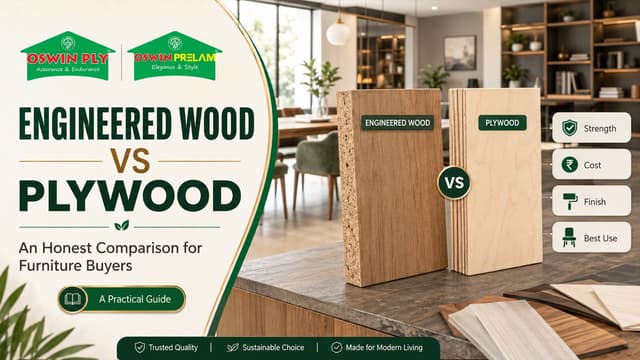
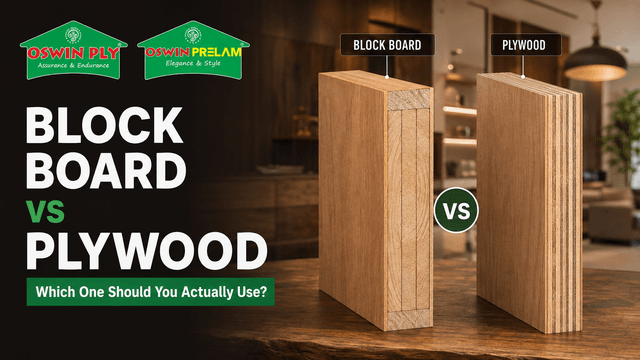
The single most useful thing to understand: HDHMR and MDF are fibreboards. Plywood is layered wood. One is made of wood dust pressed together; the other is made of wood sheets stacked at right angles. That structural difference explains almost every performance difference below.
Plywood is built from thin hardwood veneers laid with each layer’s grain running perpendicular to the one below it, then bonded under heat and pressure. That cross-grain layup is why plywood holds screws, carries load across a span, and resists bending. In BWP grade, the adhesive is phenol-formaldehyde resin, the same chemistry that survives boiling water. An 18mm BWP sheet typically has 9 to 15 plies, with 13 common. More plies of the same species means a stronger board, but ply count alone is not a quality test: a 9-ply gurjan-core sheet can outperform a 15-ply poplar one.
HDHMR is made by compressing hardwood fibres with moisture-resistant and melamine-fortified resins at very high pressure. The result is a homogeneous, void-free board with a density of roughly 750 to 870 kg/m³ (most branded HDHMR sits around 800 to 850), noticeably denser than plywood’s 550 to 750 kg/m³. Because there are no veneer layers and no grain, HDHMR machines beautifully: CNC routing comes out crisp, laminates bond flat, and there is no grain telegraphing through paint.
MDF is finer wood fibres compressed with resin at lower density. It is the smoothest and cheapest of the three, and the least tolerant of water.
| BWP Plywood (IS 710) | HDHMR / HDMR | MDF | Particle board | |
|---|---|---|---|---|
| Structure | Cross-laminated veneers | Compressed fibres, homogeneous | Compressed fibres, homogeneous | Compressed wood particles, coarser than MDF |
| Density | 550 to 750 kg/m³ | 750 to 870 kg/m³ | 700 to 800 kg/m³ | 600 to 700 kg/m³ |
| Water resistance | Best. Survives boiling water | Moderate. Swells under standing water | Poor. Avoid all wet zones | Worst. Swells unevenly, edges puff fastest |
| Screw holding | Best, including edge grain | Good on faces, weaker on edges | Weak, strips easily | Weakest of the four |
| Load bearing / spans | Best | Moderate | Poor, sags over span | Poor, sags fastest of the four |
| Surface finish | Good; grain can telegraph | Best. Flawless for laminate, PU, acrylic | Best. Flawless for paint | Coarsest. Not paintable directly |
| CNC routing / fluting | Fair, grain limits fine detail | Best | Best | Poor, coarse edges chip |
| Weight | Moderate | Heaviest (18mm 8×4 sheet approx. 40 to 48 kg) | Moderate to heavy (18mm 8×4 sheet approx. 40 to 50 kg) | Lightest (18mm 8×4 sheet approx. 25 to 35 kg) |
| Termite / borer | Treated grades resist well | Resin-bonded, resists well | Vulnerable once moisture enters | Most vulnerable, more voids than MDF |
| Indicative price | ₹90 to 150 / sq ft (BWP) | ₹60 to 80 / sq ft | ₹20 to 50 / sq ft | ₹15 to 30 / sq ft (cheapest) |
| Realistic life | 20 to 25+ years | 12 to 15 years | 5 to 6 years | 3 to 5 years (shortest) |
Prices are indicative market ranges for 2026 and vary by brand, thickness, grade and city. Ask your dealer for current rates.
Yes, this is a manufacturer that sells both plywood and HDHMR telling you HDHMR is the better choice for shutters. For a routed, laminated cabinet door, it is.
Do not use particle board for anything that takes repeated screwing, such as hinges or drawer runners, or anything that carries real weight. Of the four materials in this article, it is the weakest on both counts.
Most articles comparing these boards are published by companies that sell all three, and most only publish the flattering half. We sell HDHMR too, through our Prelam range, so we have exactly that same incentive. Here is the honest list anyway:
Swells and crumbles once water reaches it. Poor screw holding, because repeated tightening strips the fibre. Sags over any real span. In a humid Indian kitchen, standard MDF is a replacement schedule, not a material choice.
The weakest material in this article on every structural measure: screw holding, load bearing and moisture resistance. It swells unevenly at cut edges, and hinge screws commonly strip out within three to four years of daily use. It has no place in a kitchen, a wardrobe carcass, or anywhere opened and closed daily for a decade. Its place is cheap, temporary, always-laminated, never-loaded furniture, and even there, factory-laminated particle board holds up better than site-laminated, because the factory bond seals the edges more reliably than most site work does.
We would be a poor source if we skipped this:
This is the part almost no article explains, and it costs people money.
“BWP” traditionally meant IS 710: marine grade, the highest waterproof specification, tested against 72 hours of boiling water. But the term “BWP” now also appears under IS 303:2024 for general-purpose plywood. Two very different products can carry a “BWP” sticker.
So do not ask for “BWP plywood”. Ask for “IS 710 BWP / marine-grade plywood” and check the sheet itself.
For context, our own Oswin Ply Platinum is tested to 108 hours of boiling water, beyond the 72-hour IS 710 requirement. But you should not take that on trust from a blog. Which brings us to the next section.
Do these five things at the dealer, before the sheet reaches your site:
Sheet price is the wrong number to compare on its own. Here is the same comparison run over the life of the furniture, using indicative mid-range market prices:
| Board | Indicative cost | Realistic life | Cost per sq ft per year |
|---|---|---|---|
| BWP plywood | approx. ₹120 / sq ft | 20 to 25 years | ₹4.8 to 6.0 |
| HDHMR | approx. ₹70 / sq ft | 12 to 15 years | ₹4.7 to 5.8 |
| MDF | approx. ₹35 / sq ft | 5 to 6 years | ₹5.8 to 7.0 |
| Particle board | approx. ₹20 / sq ft | 3 to 5 years | ₹4.0 to 6.7 |
These are indicative market figures, not Oswin rates, and they are averages rather than quotes. On sheet price alone particle board looks cheapest, but its per-year figure sits close to BWP plywood’s, and MDF and HDHMR look close to BWP too, once you buy at the bottom of their price range. Be honest about what the table does and does not prove. The real gap is not in the sheet.
Replacement is not a sheet cost. It is a project cost. When a swollen carcass has to come out, you pay again for carpentry, hardware, edge banding, laminate and disposal, and you lose the use of the room for a week. That is typically three to five times the price of the board itself. A board that lasts 25 years is bought once. A board that lasts six is bought four times, and paid for four times over in labour.
That is why the sensible reading is not “plywood is cheaper”. It is: put the durable board where failure is expensive to fix, and the cheap board where it is not.
Experienced designers stopped choosing one board for the whole house years ago:
| Where | Use |
|---|---|
| Kitchen base cabinets, under-sink, utility | IS 710 BWP plywood. Non-negotiable. |
| Kitchen shutters and wall cabinets | HDHMR, with properly sealed edges |
| Wardrobe carcass | BWP or BWR plywood |
| Wardrobe shutters, wall panelling, TV units | MDF, HDHMR or prelam particle board, depending on finish and budget |
| Wardrobe internals, dry storage, budget work | Prelam particle board. Dry areas only. |
| Anything within two metres of a water source | BWP |
High Density High Moisture Resistant. It is an engineered fibreboard made by compressing wood fibres with moisture-resistant resins, typically at a density of 750 to 870 kg/m³. It is often written as HDMR in the market, and it is the same product.
Neither is universally better. HDHMR is better for shutters, CNC-routed panels and smooth laminated finishes. BWP plywood is better for wet zones, load-bearing furniture and anything that must last 20+ years. Choose by application, not by brand claims.
No. HDHMR is moisture resistant, not waterproof. It handles humidity and occasional splashes well, but swells under standing water, particularly at cut edges. For genuine waterproof performance, use IS 710 BWP plywood.
HDHMR resists termites reasonably well because it is resin-bonded fibre rather than solid wood. But once moisture penetrates the board, that resistance drops. Termite resistance depends on treatment quality, not on the board type alone.
No. Plywood is stronger in every structural measure: load bearing, screw holding and span. MDF’s advantage is surface smoothness, not strength.
Density and moisture resistance. HDHMR is denser (typically 750 to 870 kg/m³ versus MDF’s 600 to 800), holds screws better, and resists moisture considerably better. Both are fibreboards with the same smooth, uniform surface.
BWP is a waterproof grade of plywood tested to IS 710 against boiling water. HDHMR is a moisture-resistant fibreboard. BWP is the safer choice wherever water is present; HDHMR is the better choice where finish quality matters and moisture is occasional.
Density and strength. MDF (700 to 800 kg/m³) is denser than particle board (600 to 700 kg/m³), holds screws roughly 20 to 40% better, and resists moisture for longer. Particle board is the cheapest and lightest board in this comparison, but also has the shortest realistic life. Use it only for low-budget, always-laminated, non-structural furniture.
A mix. IS 710 BWP plywood for base cabinets and anything near the sink, HDHMR for shutters and wall units with sealed edges, and no standard MDF or particle board anywhere near water. In coastal and high-humidity cities, extend BWP to the full carcass.
Particle board is cheapest per sheet, then MDF, then HDHMR, with BWP plywood the most expensive. Measured per year of service the gap narrows sharply: particle board and MDF are replaced so often that their per-year cost sits close to BWP plywood’s, not far below it.
We would not. Base cabinets sit on the floor, where leaks and mopping water pool. HDHMR edges swell under sustained moisture, typically within 12 to 18 months. Use IS 710 BWP plywood for the carcass and put your HDHMR in the shutters.
Written by Mr. Balakrishna Iyer, GM – Sales (Tamil Nadu), Oswin Ply (Oswin Wood Panels Pvt. Ltd), a Chennai-based plywood and block board manufacturer. We manufacture ISI-certified BWP plywood, marine plywood, flush doors, block boards and Prelam boards, including HDHMR-core options, supplying dealers across Tamil Nadu, Karnataka, Andhra Pradesh, Telangana, Maharashtra and Goa.
If you are specifying boards for a project in Tamil Nadu, Karnataka, Andhra Pradesh, Telangana, Maharashtra or Goa, talk to us before you buy, even if the answer turns out to be a board we don’t sell. Call 044 2669 0023 or find your nearest Oswin dealer.