

Flush door is one of the most searched terms in the door category, and for good reason: it is the most common interior and exterior door type in Indian homes today. This guide covers what is meant by a flush door, the difference between solid core and hollow core construction, and how to check quality before you buy. For style and room-by-room ideas, see Oswin Ply’s Interior Flush Door Design Ideas guide, this piece focuses on what the door is actually made of.
A flush door is a flat, smooth-surfaced door with no visible panels, mouldings, or raised sections, the opposite construction approach to a panel door. The name comes from the surface sitting “flush,” completely level, across the whole face of the door. A flush door is built by bonding a plywood or laminate face sheet over an internal core, and that core is what actually determines the door’s weight, strength, and price.
This is the single most important spec question to ask when buying a flush door, and it is also one of the most searched questions on the topic.
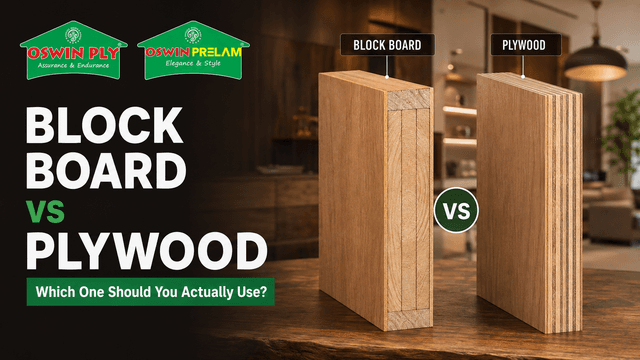
Solid core flush doors are filled edge to edge with a dense material; blockboard, particle board, or a solid wood-block core are the most common. A solid core door is heavier, offers better sound insulation, holds hardware and hinges more securely over time, and generally performs better against warping.
Hollow core flush doors use a honeycomb or frame structure inside, with only a thin perimeter frame carrying real weight, the rest of the interior is largely air. Hollow core doors are lighter and less expensive, but offer less sound insulation and are more prone to denting or damage from impact.
Which one is best for you comes down to where the door goes. Solid core is the stronger choice for main entrances, main bedroom doors, and any flush door for bathroom use where moisture and sound insulation both matter. Hollow core is a reasonable, cost-effective choice for low-traffic interior doors like a storeroom or an internal passage door.
A flush door starts with the internal core, solid or hollow, built to the door’s final dimensions. A face sheet, usually plywood, MDF, or laminate, is then bonded to both sides under pressure, and the edges are finished or lipped to protect the core from moisture and impact. The quality of that bonding, along with the core material itself, is what separates a door that lasts for years from one that starts to delaminate or warp within a season or two.
What is flush door construction, in short: a flat, panel-free door made by bonding a plywood or laminate face sheet over an internal core, solid or hollow, so the whole surface sits level with no raised or recessed sections.
Solid core flush doors are durable enough for main entrances and high-traffic areas when properly installed and edge-sealed. Hollow core doors are durable enough for low-traffic interior use but are not the right choice for exterior or heavy-use doors.
Yes, but a solid core flush door with proper moisture-resistant grading is the right choice for bathrooms specifically, given the sustained humidity. A standard hollow core door is not recommended for that environment.
Neither is universally “best,” it depends on placement. Solid core is the stronger, longer-lasting choice for main doors, bedroom doors, and bathrooms. Hollow core is a lighter, more affordable option for low-traffic interior doors where sound insulation and impact resistance matter less.
Oswin Wood Panels manufactures solid-core and hollow-core flush doors, alongside panel doors, ISI-certified plywood, block board and Prelam boards, from Chennai. Our team can help match core type and grade to exactly where each door will be installed.
Call 044 2669 0023 or find your nearest Oswin dealer.
Written by Mr. Balakrishna Iyer, GM – Sales (Tamil Nadu), Oswin Ply (Oswin Wood Panels Pvt. Ltd), a Chennai-based plywood and block board manufacturer. We manufacture ISI-certified BWP plywood, marine plywood, flush doors, block boards and Prelam boards, including HDHMR-core options, supplying dealers across Tamil Nadu, Karnataka, Andhra Pradesh, Telangana, Maharashtra and Goa.