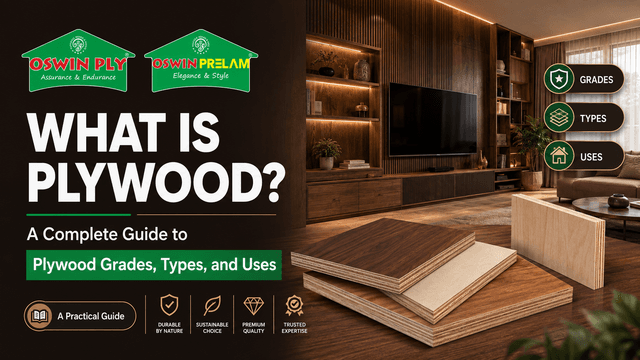


If you have been comparing boards for a wardrobe, kitchen cupboard, or modular furniture project, you have probably come across the term pre-laminated particle board, often shortened to prelam board or pre-laminated board. This guide covers what it actually is, the full range of colours and finishes available, standard sizes and what drives particle board price, and where it works best in a home or office.
Particle board, also called laminated board or particle wood board, is an engineered wood panel made by bonding wood particles and resin together under heat and pressure into a flat sheet. That is the simplest answer to what particle board is and what the term particle board meaning covers across the industry.
On its own, raw particle board has a plain, slightly rough surface. Once a decorative laminate is fused onto both faces during manufacturing, it becomes pre-laminated particle board, ready to use straight out of the box with no additional polishing, painting, or edge banding needed before installation. This is also the difference between the main types of particle board on the market: raw/unfinished board and pre-laminated board that arrives finish-ready.
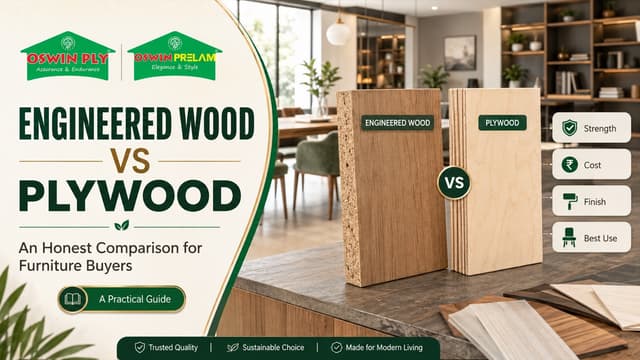
It is worth knowing this alongside the difference between engineered wood and particle board as terms. “Engineered wood” is the umbrella category; it includes particle board, MDF, and plywood, all three are manufactured panels rather than solid natural timber. Particle board specifically means the wood-particle-and-resin version, which is a different core structure from plywood’s layered veneer.
One of the most common questions on pre laminated particle board colours is simply what is actually available to choose from. Oswin Prelam covers two broad ranges:
Solid colours: flat, uniform shades including Yellow, Warm Grey, Super White, Slate Grey, Silver Grey, Saffron, Pink, Parrot Green, Mocha Brown, Metal Grey, Ivory, Graphite Grey, Gothic Grey, Frosty White, Everest White, Electric Blue, Charcoal, Blood Red, and Black.
Wood grain finishes: laminates that replicate natural wood textures, including American Walnut, Asian Wood, Bavarian Beech, Chestnut Dark, Chestnut Cream, Classic Planked Walnut, Grenada Pine, Mahogany, Natural Teak, Oxford Cherry, Sanoman Oak Dark, Urban Teak, and Wyoming Maple, among others.
Both ranges are built for particle board furniture designs and everyday particle board design work, so a wardrobe interior, particle board cupboard carcass, or shelving unit can be matched to a specific colour or grain finish instead of settling for whatever a local supplier happens to have in stock. Browse the full range on the Solid Colours and Wood Grain Finishes pages.
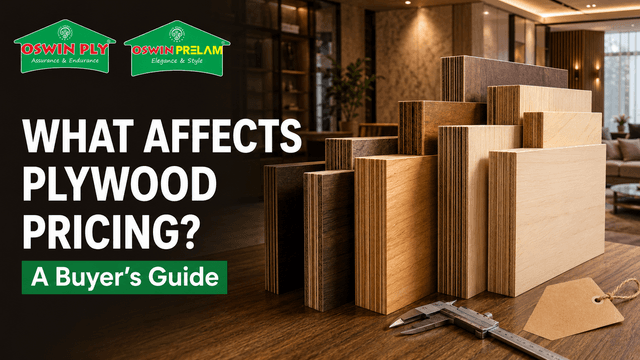
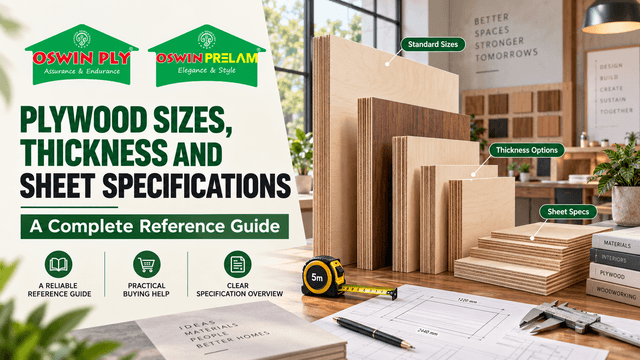
Particle board price is one of the most searched questions in this category, and thickness is the single biggest factor behind it. The common thicknesses are:
Standard sheet size across the industry is 4x8 feet (8 x 4 feet), matching plywood, though 6 x 4 feet sheets are also available for smaller cuts. Beyond thickness, price is driven by:
For an exact quote on a specific thickness and colour, the fastest route is your nearest Oswin Ply dealer. As with any particle board supplier, price also moves with local supply and order volume, so a dealer quote will always be more accurate than a general estimate. It is also worth asking your dealer which particle board manufacturers they stock from; quality varies more by manufacturer than most buyers expect.
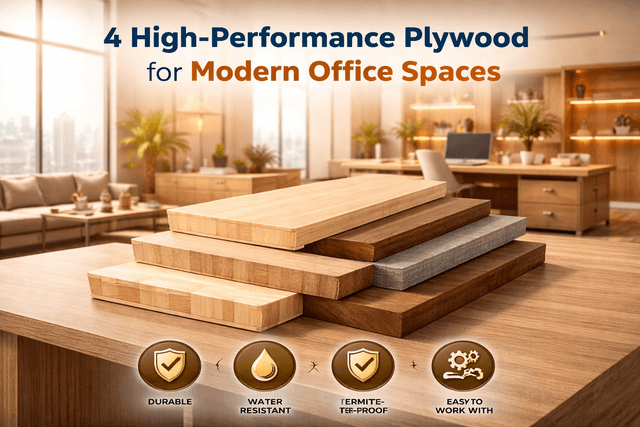
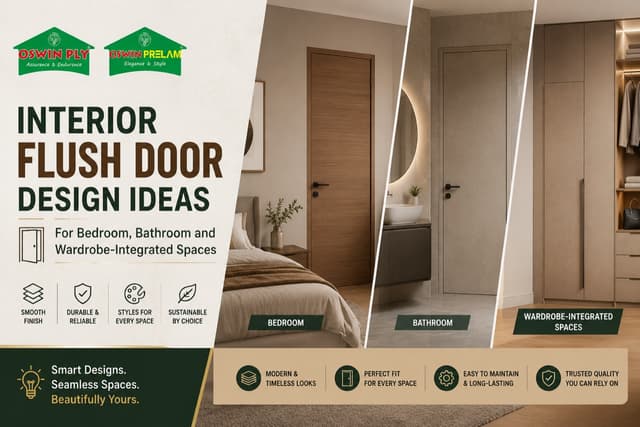
Particle board furniture is one of the most common applications in Indian homes today, largely because pre-lamination removes the finishing step entirely. It shows up most often in:
Particle board is not the right choice for every application, though. Areas with sustained water exposure, or heavy load-bearing structural use, are better served by BWP or marine-grade plywood instead, that trade-off is really what most “which board should I use” decisions come down to.
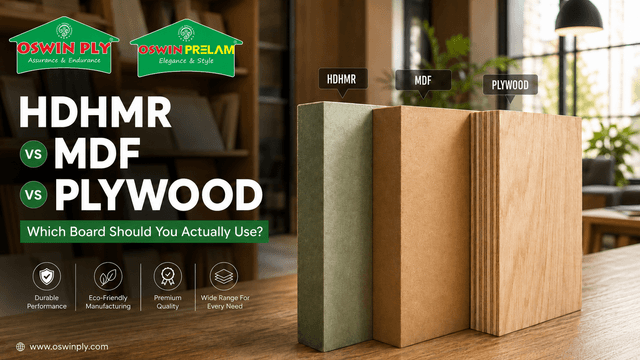
Particle board, MDF, and plywood get compared constantly, so it helps to have the basic difference in one place:
| Board | Made from | Best for |
|---|---|---|
| Particle board | Wood particles and resin | Modular furniture, budget-friendly interiors |
| MDF | Fine wood fibres, denser | Detailed carving, routed designs |
| Plywood | Layers of wood veneer | Load-bearing furniture, structural use |
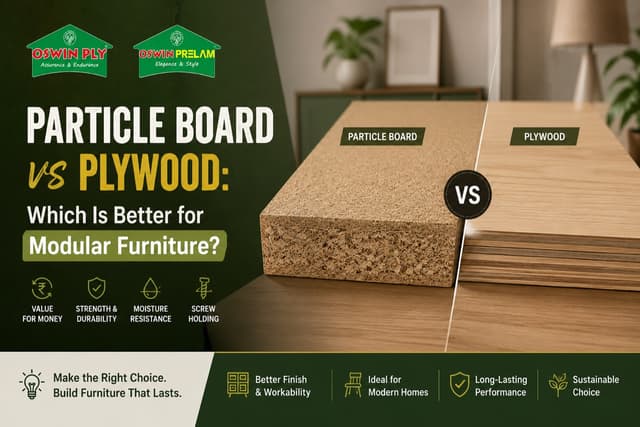
For a full breakdown against plywood specifically, see Oswin Ply’s Particle Board vs Plywood comparison.
No. Plywood is built from layers of wood veneer glued together, while particle board is made from compressed wood particles and resin. Both are engineered wood, but the manufacturing process and structural strength differ.
Neither is strictly “better”; they suit different jobs. Particle board is generally more affordable and works well for flat panels like wardrobe shutters and cabinet carcasses. MDF is denser and machines more cleanly, so it suits detailed or routed designs. For straightforward modular furniture, particle board is usually the more cost-effective choice.
For the applications it is designed for, modern particle board, especially at 18mm and above, holds screws and fittings well and is a standard choice for wardrobes and cabinets across the furniture industry. Exactly how much weight particle board can hold depends on thickness, support spacing, and hardware quality; for shelving carrying heavy loads, ask your dealer about reinforced fittings or step up to a thicker panel. For very heavy load-bearing use, plywood or block board is the better fit.
Particle board manufactured with proper resin bonding is more resistant to insect damage than raw, untreated wood, but no wood-based board, particle board included, should be marketed or bought as fully immune to termites. Pairing any board with sound site practices, sealed edges, and a dry installation area gives the best real-world protection.
Reputable particle board is manufactured to formaldehyde emission standards that make it safe for interior residential use, so on the question of whether particle board is bad for health, a properly certified board is not a concern for normal residential use. If indoor air quality is a specific concern, ask your dealer about the resin type and emission grade of the exact board before you buy.
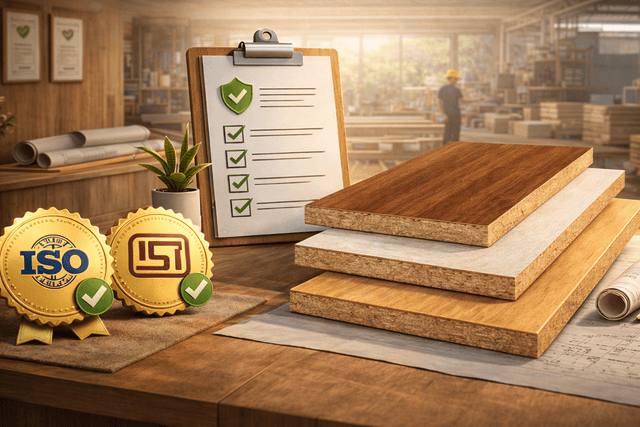
Oswin Prelam offers pre-laminated particle board in a wide range of solid colours and wood-grain finishes, alongside Oswin Ply’s ISI-certified plywood, block board and flush doors, from Chennai. Ask us for colours, thickness options and an exact quote.
Call 044 2669 0023 or find your nearest Oswin dealer.
Written by Mr. Balakrishna Iyer, GM – Sales (Tamil Nadu), Oswin Ply (Oswin Wood Panels Pvt. Ltd), a Chennai-based plywood and block board manufacturer. We manufacture ISI-certified BWP plywood, marine plywood, flush doors, block boards and Prelam boards, including HDHMR-core options, supplying dealers across Tamil Nadu, Karnataka, Andhra Pradesh, Telangana, Maharashtra and Goa.