

The quick answer
Plywood is not one price; it is a stack of decisions, and each one moves the number. Grade is the biggest single factor: MR is the cheapest, BWR sits in the middle, and BWP or marine grade costs the most, because the adhesive itself gets more expensive as water resistance goes up. After grade, the core wood species matters (gurjan costs more than eucalyptus, which costs more than poplar), then thickness, then brand and warranty, then certification, then where you are buying relative to where the timber comes from. None of these is negotiable away without a real trade-off in what you get.
If you are staring at two quotes that look wildly different for “the same plywood,” one of these factors is almost always the reason.
Plywood grade is really an adhesive and testing specification, and the adhesive is where most of the price difference comes from.
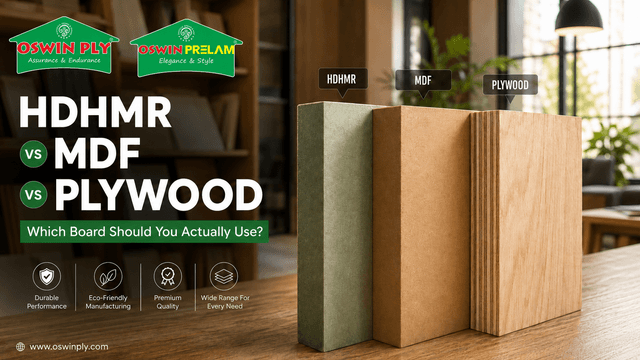
Buying MR for a wet area to save money on the sheet is one of the most common ways people overspend later, we covered this in detail in our HDHMR vs MDF vs Plywood guide, the cheap board is usually the expensive board once you count the replacement.
Not all plywood cores are the same timber, and species is a real cost driver independent of grade.
Species and ply count interact in a way that surprises people: a 9-ply gurjan-core sheet can genuinely outperform a 15-ply poplar sheet of the same thickness, ply count alone is not a quality signal, species is at least as important.
The straightforward one: more material, more cost. An 18mm sheet costs more than a 12mm sheet of the identical grade and species, because there is simply more wood and resin in it. Do not buy thicker than the application needs. A correctly specified 12mm partition panel does not need to be 18mm just because 18mm feels sturdier in the shop.
A calibrated sheet, one sanded to a precise, consistent thickness across its entire surface, costs more than an uncalibrated one, and for a specific reason: it removes a real problem at the lamination stage. An uncalibrated sheet with thickness variation across its surface causes visible high and low spots once laminate is pressed onto it. Calibration is a manufacturing step, and manufacturing steps cost money, but for anything getting a laminate or veneer finish, it is one of the few premiums that is worth paying for directly.
Established manufacturers with real quality infrastructure charge more, and the honest reason is consistency: thickness tolerance, glue line uniformity, and surface finish are harder to guarantee at scale than they look. Warranty length is part of this too, longer warranties generally mean the manufacturer is confident enough in their own construction to stand behind it for longer, which is a real signal, not just a marketing line, provided the warranty terms are specific rather than vague.
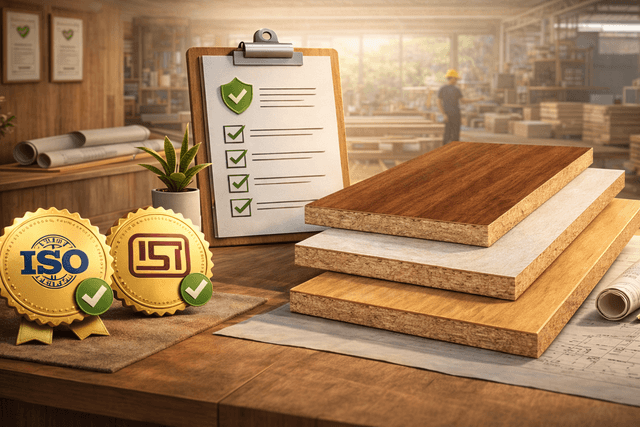
ISI marking under BIS is mandatory for the grades covered in this guide, and getting certified costs the manufacturer money in testing, documentation, and compliance infrastructure, that cost is in the sheet price. Increasingly, buyers also ask for FSC or PEFC certification (responsible timber sourcing) and E0/E1 emission ratings (low-formaldehyde off-gassing), both add real compliance cost for a manufacturer that holds them properly, and both are reasonable things to ask a dealer to show you, not just claim.
Plywood manufactured closer to its timber source is often cheaper regionally, transportation adds real cost, especially for a bulky, heavy product like plywood sheets. This is one reason prices for what looks like an identical product can differ meaningfully between cities.
This is worth knowing before you budget a project. Timber prices for poplar and eucalyptus, two of the most common core species, rose roughly 10 to 15% through 2026 on seasonal shortages and lower tree-felling rates. Resin costs are tied to broader chemical and oil markets and have moved with them. Combined, the plywood and panel industry has seen manufacturer-side price increases in the range of 5 to 15% this year. None of this is specific to any one brand, it is an industry-wide raw material story, and it means “wait for prices to drop” is not currently a realistic strategy. Buying the correctly specified grade and controlling waste matters more than timing the market.
Always convert to price per square foot, not price per sheet. A standard sheet is 8 feet by 4 feet, 32 square feet. Divide the sheet price by 32 and you get a number you can genuinely compare across different sheet sizes and thicknesses.
Ask for the grade by its IS number, not just a word. “Waterproof” is not a grade, IS 710 BWP is. A dealer who can quote you the standard number is quoting you a real specification. A dealer who cannot is quoting you a marketing term.
Check the glue line colour. Phenol-formaldehyde, the BWP adhesive, leaves a dark reddish-brown line between plies. A light or cream-coloured glue line on a sheet sold as BWP is a red flag, that is what urea-formaldehyde, the MR adhesive, looks like.
Get the warranty in writing, with specific terms. “Lifetime” is not a term you can act on if something goes wrong in year eight. A specific number of years, tied to specific conditions, is worth more than an impressive-sounding word.
These are general Indian market ranges for 2026, gathered from public industry pricing guides, not Oswin’s own rates. They exist so you have a sense of scale while reading this guide, not as a quote.
| Grade | Typical range (per sq ft) | What it is for |
|---|---|---|
| MR (IS 303) | Rs 35 to 70 | Dry interior work only |
| BWR | Rs 70 to 100 | Humidity and occasional splashes |
| BWP / Marine (IS 710) | Rs 90 to 150 | Kitchens, bathrooms, anything that gets wet |
Prices vary by thickness, core species, brand, and region, and change with raw material market conditions. Always confirm current rates with a dealer before budgeting a project.
Because “plywood” is not one product. Grade, core species, thickness, brand, and certification all move the price independently, and a quote that skips naming most of these is not comparable to one that names all of them.
Not automatically, but the price difference usually reflects something real: better adhesive, denser core species, tighter manufacturing tolerance, or a longer warranty. The question is whether that specific thing matters for your application, not whether the price is high.
Phenol-formaldehyde resin, the adhesive used in BWP grade, costs more to produce than the urea-formaldehyde used in MR grade, and BWP goes through more testing to meet IS 710. The price difference is the adhesive and the testing, not markup.
Yes, proportionally. A thicker sheet uses more raw material, and the cost scales with it. Buy the thickness the application actually needs, not the thickest option available.
Unlikely in the near term. Timber and resin costs are both under upward pressure this year, and the realistic strategy is buying the correct grade and controlling waste, not waiting for a price drop.
Convert every quote to price per square foot (sheet price divided by 32 for a standard 8x4 sheet), and make sure you are comparing the same grade, thickness, and species before comparing numbers.
MR grade, because it uses the cheapest adhesive and is not tested for water resistance. It is appropriate only for dry interior applications.
It is a real factor, not just marketing, provided the brand backs it with specific, verifiable claims: a named test standard, a specific warranty period, and certification you can check, not just a brand name on its own.
Written by Mr. Balakrishna Iyer, GM – Sales (Tamil Nadu), Oswin Ply (Oswin Wood Panels Pvt. Ltd), a Chennai-based plywood and block board manufacturer. We manufacture ISI-certified BWP plywood, marine plywood, flush doors, block boards and Prelam boards, including HDHMR-core options, supplying dealers across Tamil Nadu, Karnataka, Andhra Pradesh, Telangana, Maharashtra and Goa.
The ranges in this guide are general market context, not a quote.
Call 044 2669 0023 or find your nearest Oswin dealer for current pricing on the grade and thickness your project actually needs.