

Three door types get asked about constantly and compared almost never. Flush and panel doors are well understood on their own, membrane doors less so, and almost nobody explains how the three actually sit against each other when you are standing in front of a dealer trying to pick one.
| Door type | Core construction | Finish | Best for |
|---|---|---|---|
| Membrane | MDF/particle board core, PVC membrane wrap | Seamless, no visible grain, wide colour range | Wet-area interior doors, modern flush look on a budget |
| Flush | Solid or hollow plywood core, flat faces | Laminate, veneer, or paint over ply | Main doors, bedroom doors, most general use |
| Panel | Framed stiles and rails with raised or recessed panels | Traditional, textured, often painted | Entrances, traditional or classic interiors |
A membrane door is built by vacuum-pressing a PVC membrane sheet over an MDF or particle board core under heat, producing a completely seamless, grain-free surface in a wide range of solid colours and wood-look finishes. Because the finish is applied as a single wrapped layer rather than a laminate sheet or paint coat, membrane doors resist chipping at the edges better than a painted MDF door, and the finish rarely shows tool marks or seams the way laminate sometimes does at joints.
The manufacturing process itself is what gives membrane doors their distinctive look. The core is first CNC-routed into the desired panel design, grooves, bevels, or flat profiles, and then the PVC membrane is heated and vacuum-pressed over the entire surface in one continuous sheet, following every contour of the routed design. This is why membrane doors can achieve raised-panel or moulded looks at a lower cost than genuine timber panel doors, the visual detail comes from the routing, not from assembling separate framed pieces.
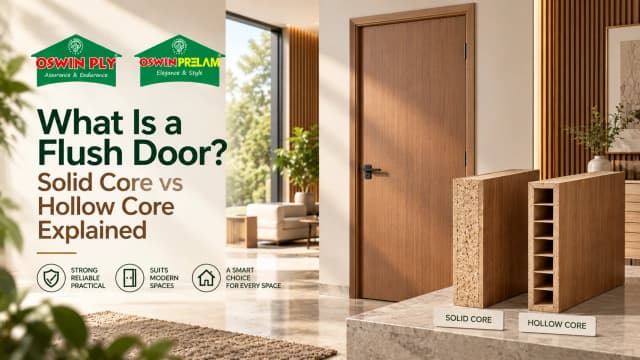
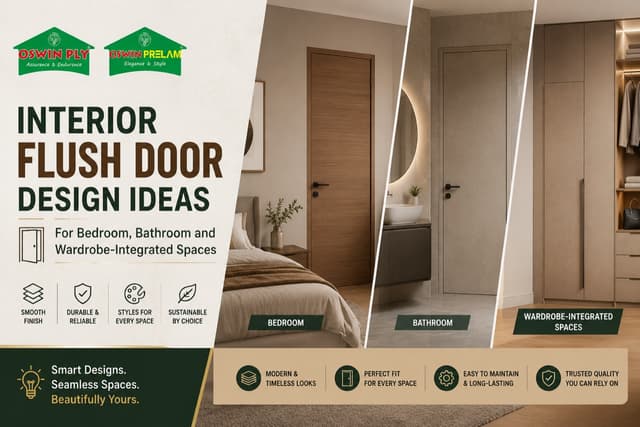
A flush door is a flat-faced door built on a solid or hollow plywood core, finished with laminate, veneer, or paint. It is the most common door type in Indian homes, straightforward, structurally simple, and available across a wide range of core densities and finishes. See the full Flush Door guide for solid versus hollow core construction and how to check quality before buying.
A panel door is built from a solid timber or engineered frame, stiles and rails, with raised or recessed panels set into it rather than a flat single-piece face. It carries a more traditional, dimensional look and is the door type most associated with classic and heritage-style interiors. See the full Panel Doors guide for the type-by-type breakdown of raised, recessed, louvered, and glass panel styles.
Membrane doors are generally positioned as a mid-range option, more than a basic painted flush door but often less than a laminate-finished flush door or a genuine timber panel door at a comparable size. The exact positioning shifts by region and finish complexity, a simple flat membrane door competes closely with a basic laminate flush door, while an elaborate multi-panel membrane design can approach panel door pricing without matching a solid timber panel door’s structural mass. Always compare quotes at the same size, core thickness, and finish complexity, cost comparisons across door types are only meaningful when the specification is genuinely equivalent.
Membrane doors generally accept standard hinges and hardware without special modification, since the MDF or particle board core behaves similarly to other engineered cores for fastening purposes. The one practical difference worth planning for is that repeated hardware adjustment, removing and reinstalling hinges multiple times, can wear the screw holes in an MDF core faster than in a denser plywood core. For doors expected to be adjusted or rehung occasionally, reinforcing the hinge mortises during installation is a small step that prevents a larger repair later.
Membrane doors typically offer the widest colour and finish range at the lowest cost of the three, since the membrane wrapping process supports solid colours, wood-look prints, and matte or gloss finishes with equal ease. Flush doors offer flexibility primarily through the finish applied afterward, laminate, veneer, or paint, rather than through the door’s core shape. Panel doors offer the most flexibility in dimensional design, the number, shape, and arrangement of panels, but the least flexibility in colour without a separate paint or stain finish applied on-site. Matching the design goal to the door type’s natural strength avoids fighting the material to achieve a look it was not built for.
Start from the room, not the door type. If the room sees regular moisture, bathrooms, utility areas, kitchens with integrated cabinetry doors, membrane construction’s seamless surface is the practical starting point. If the room is a standard dry interior space with no special aesthetic requirement, a flush door is the simplest, most cost-effective, and most repairable long-term choice. If the door is a main entrance, a formal room divider, or anywhere the traditional, dimensional look matters more than cost, panel construction on a solid core is worth the additional investment. Very few homes need only one door type throughout, and mixing types by room is standard practice rather than a compromise.
A door with an MDF or particle board core wrapped in a vacuum-pressed PVC membrane, giving a seamless, grain-free, wide-colour-range finish.
The membrane surface resists surface moisture well, but the MDF or particle board core underneath is not, edge sealing and installation quality matter more than the membrane itself for wet-area durability.
It varies by finish level on both sides, a basic membrane door is often competitive with a laminate flush door, ask your dealer for a like-for-like comparison at the same size and core density.
It’s possible but not ideal, a flush or panel door on a solid plywood or timber core generally holds up better to daily entrance-level traffic and weather exposure.
With proper edge sealing and away from direct water exposure, membrane doors hold up well for many years, the finish is generally more durable against daily wear than paint, though less repairable if damaged.
Not easily, the PVC membrane does not take paint or refinishing the way a laminate or painted flush door does, damage typically means replacing the affected panel rather than restoring it.
No, standard hinges and handles fit membrane doors without modification, the core material behaves like other engineered wood cores for fastening purposes.
Membrane doors are often a practical choice for rentals, the uniform, damage-resistant surface and moderate cost suit a property that needs to look consistent and hold up to tenant turnover without the higher investment of panel doors.
Oswin Wood Panels manufactures flush and panel doors alongside ISI-certified plywood, block board and Prelam boards, from Chennai. Our team can help match door type, core and finish to each room’s real demands.
Call 044 2669 0023 or find your nearest Oswin dealer.
Written by Mr. Balakrishna Iyer, GM – Sales (Tamil Nadu), Oswin Ply (Oswin Wood Panels Pvt. Ltd), a Chennai-based plywood and block board manufacturer. We manufacture ISI-certified BWP plywood, marine plywood, flush doors, block boards and Prelam boards, including HDHMR-core options, supplying dealers across Tamil Nadu, Karnataka, Andhra Pradesh, Telangana, Maharashtra and Goa.