

Walk into a carpenter's workshop in India and you will hear the word mica far more often than the word laminate. A wooden mica sheet is the thin, decorative surface pasted onto plywood to give it a wood grain, a colour or a gloss. It is what turns a plain board into a finished kitchen shutter or wardrobe door.
This guide explains what wooden mica and wood laminate sheets are, how inner laminate differs from the face you see, which finishes and thicknesses to choose, and how laminate furniture is put together so that it lasts. The search for laminate sheets covers a huge range of products, so this guide stays with the ones used on plywood.
In everyday Indian use, mica is simply the word for decorative laminate. Wood laminate sheets, wooden mica and laminate material all describe the same thing: a thin sheet made of layers of paper soaked in resin and pressed into a hard, smooth surface. HPL, short for high-pressure laminate, is the technical name for the common type.
The sheet itself has no strength. It gives the surface its look and its resistance to scratches and wear, and the plywood underneath gives the panel its strength.
Outer laminate is the decorative face you see. Inner laminate is a plain, usually thinner sheet used on the hidden faces, such as the inside of a wardrobe or the back of a shutter. An inner laminate sheet balances the outer one, so that the panel does not pull to one side as the humidity changes. Leaving the hidden face bare is the commonest reason a laminated shutter bows.
| Where it goes | Laminate | Note |
|---|---|---|
| Vertical surfaces: shutters and side panels | About 0.8 mm | Good for most doors and panels |
| Horizontal surfaces that take wear: worktops and tables | 1 mm or more | Harder-wearing under daily use |
| Hidden faces | Inner laminate, usually thinner | Keeps the panel balanced |
| Exposed edges | Edge band to match | Protects the core and finishes the look |
Buyers use these phrases in two ways. Mica plywood can mean a plywood board that already has mica pressed on at the factory. A plywood mica sheet or a wooden mica sheet can mean the loose laminate sheet that your carpenter will fix to plywood. Ask the dealer which one is meant before you order. Laminated Plywood: Types, Finishes and Where to Use It explains the pre-laminated option.
Laminate furniture also suits rented homes and busy family rooms, where a surface that wipes clean and resists scratches matters more than a natural feel. It is a poor fit outdoors and for any surface that sits in standing water, because water enters at cut edges and joints.
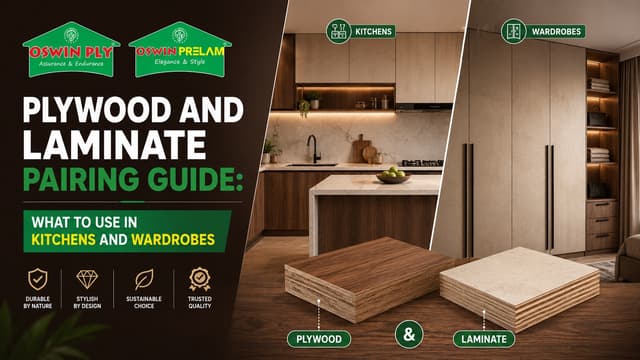
A laminate sheet does not make plywood water resistant. The surface sheds splashes, but the board underneath still needs the right grade for the zone. Choose the grade of the plywood first, then the laminate. Plywood with laminate finish also needs the same care at its edges as any other board, because the cut edge is where moisture enters. The zone-by-zone rules are in Plywood and Laminate Pairing Guide: What to Use in Kitchens and Wardrobes.
| Finish | Look | Care |
|---|---|---|
| Laminate | Printed pattern, uniform | Wipe clean, hard-wearing |
| Veneer | Real wood grain, varies by sheet | Needs polish or PU, avoid standing water |
| Paint | Solid colour | Needs a smooth base, touch up chips |
For most home furniture, a general-purpose laminate on the visible face and an inner laminate sheet on the hidden face is the right pairing.
Laminate furniture is only as good as its edges. A cut edge of plywood shows the layers and lets moisture in, so every exposed edge needs a band. Edge banding in a matching colour gives a clean look. A thicker band also protects the corners on shutters and tabletops, which take the most knocks. Fit the band with a clean, even press, and trim it flush so that the edge does not catch on clothes or hands.
| Problem | Likely cause | Prevention |
|---|---|---|
| Bubbles under the sheet | Trapped air or uneven adhesive | Spread adhesive evenly and roll from the centre outwards |
| Edges lifting | Heat, moisture or an unsealed edge | Band every edge and keep heat sources away |
| Colour mismatch | Sheets from different batches | Buy all sheets for one job together |
| Panel bowing | Laminate on one face only | Use inner laminate on the hidden face |
| Chipped corners | Poor trimming | Trim with the right tool and finish with a light bevel |
Wipe laminate with a soft, damp cloth and dry it afterwards. Avoid abrasive pads and strong cleaners, which dull the surface. Use pads under hot pans and keep hot appliances off laminate worktops. Wipe up water at once if it reaches an edge, because moisture is what lifts bands.
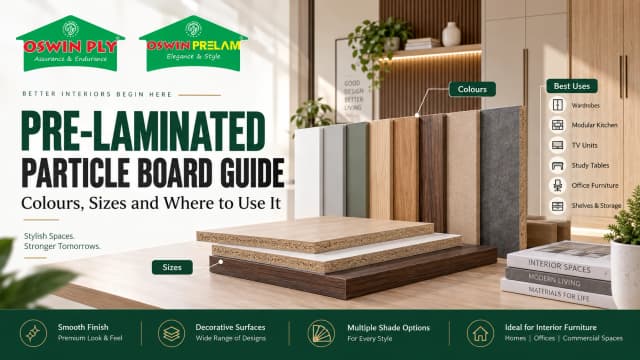
Oswin Ply makes plywood and prelam particle board, and sells them through authorised dealers, so a finished board is also an option when you want the laminate already bonded on. Pre-Laminated Particle Board Guide: Colours, Sizes and Where to Use It sets out the colours and sizes.
In everyday Indian use, yes. Mica is the common word for decorative laminate, and wooden mica means a laminate with a wood-grain look.
It is a plain, usually thinner laminate used on the hidden faces of a panel, to balance the decorative outer face.
Commonly about 0.8 mm on vertical surfaces such as shutters, and 1 mm or more on horizontal surfaces that take wear, such as worktops.
No. The laminate sheds splashes, but the water resistance comes from the plywood grade and from sealed edges.
Yes. Use the decorative laminate on the visible face and inner laminate on the hidden face, so the panel stays flat.
Laminate is harder-wearing and easier to clean. Veneer gives a natural look and needs a protective polish.
With contact adhesive on both surfaces, pressed firmly in place, then trimmed and edge banded.
Fit edge banding on every exposed edge, keep heat and standing water away from the edge, and use a good contact adhesive pressed firmly in place.
Oswin Wood Panels manufactures ISI-certified plywood, block board, flush doors and Prelam boards from Chennai. Find your nearest Oswin Ply dealer and name the board, grade and thickness you want.
Call 044 2669 0023.
Written by Mr. Balakrishna Iyer, GM – Sales (Tamil Nadu), Oswin Ply (Oswin Wood Panels Pvt. Ltd), a Chennai-based plywood and block board manufacturer. We manufacture ISI-certified BWP plywood, marine plywood, flush doors, block boards and Prelam boards, including HDHMR-core options, supplying dealers across Tamil Nadu, Karnataka, Andhra Pradesh, Telangana, Maharashtra and Goa.