

Commercial plywood is the term dealers reach for constantly and the one with the least fixed meaning. Unlike MR and BWP, it isn’t a single certified grade, and that ambiguity is exactly why it’s worth explaining properly before you agree to it as a spec on a quote.
Commercial grade plywood is trade terminology for general-purpose interior plywood, built to a lower moisture-resistance and finish standard than MR or BWP. Unlike MR (IS 303) or BWP (IS 710), “commercial” is not itself a fixed Bureau of Indian Standards certification, so its exact quality varies more by manufacturer than either of those two grades does. It is the right call for short-life, budget, genuinely dry applications, and the wrong one for anything you expect to last.
This is the detail most listings skip. MR plywood is certified to IS 303, BWP to IS 710. “Commercial grade” describes a market positioning, a lower-cost, lower-specification interior board, rather than a single certified standard, which means two boards both sold as “commercial” can genuinely differ in core quality, resin, and ply count. Always ask what standard, if any, the specific sheet is certified to, and treat a dealer’s willingness to answer that question as a signal in itself.
The term emerged as market shorthand for plywood that did not meet MR or BWP specification but was still usable for non-structural, budget-driven work, shuttering, temporary fit-outs, low-cost partition panels. Over time it broadened into a general label for anything positioned below MR on price, regardless of the actual resin or veneer quality behind a specific sheet. That drift is precisely why the term now covers such a wide quality range in practice, and why it deserves more scrutiny at purchase than its casual use in conversation suggests.
| Factor | Commercial | MR (IS 303) | BWP (IS 710) |
|---|---|---|---|
| Certification | No fixed IS standard | IS 303 | IS 710 |
| Moisture handling | Minimal | Everyday humidity | Sustained exposure |
| Price | Lowest | Mid | Highest |
| Typical ply count | Lower for given thickness | Standard | Standard to higher |
| Best for | Budget, non-structural, dry interior fit-outs | General dry furniture | Kitchens, exteriors, moisture zones |
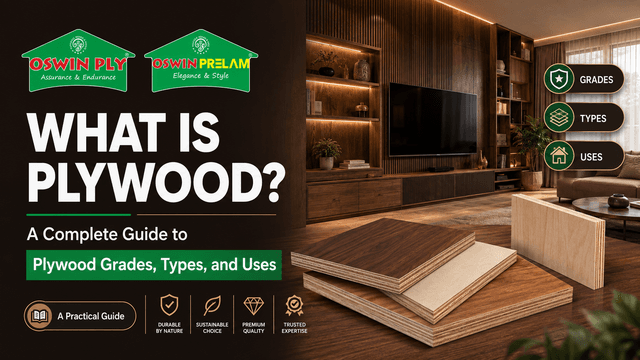
For the full grade ladder and how each tier is specified, see our complete guide to Plywood Grades, Types and Uses.
Because there is no fixed standard behind the label, the gap between the best and worst boards sold as commercial grade is wider than the gap between the best and worst MR or BWP boards from reputable manufacturers. An established brand’s commercial line is typically built with more consistency than an unbranded or small-mill product carrying the same label, simply because a recognisable brand has more reputation at stake in each sheet performing reasonably within its intended use. This is one of the few genuinely useful shortcuts available when the underlying specification itself cannot be fully verified at the point of sale.
If you can answer yes to both of the following, commercial grade is a reasonable choice: will this piece be replaced or renovated within a few years regardless of the board’s condition, and will it genuinely never see moisture beyond ambient room humidity. If either answer is no, the small price difference to MR grade buys meaningfully more durability, and is very rarely worth skipping to save what usually amounts to a modest percentage of the total furniture cost.
The term covers two genuinely different use cases that are worth separating. In construction, commercial grade shuttering plywood is a legitimate, well-understood, short-life product, used to form concrete and then discarded or reused a limited number of times, where long-term moisture resistance was never the requirement. In furniture, the same label gets applied more loosely, sometimes to a board that is simply a manufacturer’s lowest-cost interior line rather than anything purpose-built for a specific short-term application. Knowing which context you are buying in changes what questions are worth asking, a shuttering-grade board being offered for wardrobe construction deserves more scrutiny than the same grade being used for its intended construction purpose.
What passes for commercial grade in one city or from one manufacturer is not guaranteed to match another, more than any other grade discussed in this cluster. MR and BWP are anchored to fixed IS standards, which limits how much they can vary between sellers. Commercial grade has no such anchor, so a board sold as commercial grade in one market may be noticeably better or worse built than one carrying the same label elsewhere. This is the strongest practical reason to verify specifications directly with each dealer rather than assuming consistency based on past experience with the term in a different city or from a different supplier.
In practice, a dealer using the word commercial is usually signalling price tier rather than a specific technical claim, it tells you the board sits below MR on the shelf, not precisely what resin or veneer construction went into it. This is not necessarily dishonest, it reflects how the term has always functioned in the trade, but it does mean the burden of verification sits with the buyer rather than the label. Asking direct, specific questions, resin type, IS certification if any, ply count for the thickness, converts a vague price-tier label into an actual specification you can compare across dealers and brands.
For short-life, budget, dry-interior furniture, yes. For anything expected to last years or face any moisture, MR grade is a small step up in cost for a meaningful step up in durability.
Not necessarily, commercial grade has no fixed IS certification the way MR (IS 303) does. Ask specifically what standard the sheet is certified to before assuming they’re equivalent.
It varies by thickness and brand, and is generally the lowest-priced plywood category, ask your dealer for current per-sheet rates by thickness.
Yes, this is one of its most common and appropriate uses, short-term structural support during construction where long-term moisture resistance is not required.
Lower-grade resin, less stringent veneer selection, and in some cases fewer or thinner plies for a given thickness, all of which reduce manufacturing cost but also reduce durability and moisture tolerance.
Yes, for its intended dry, non-structural applications it poses no particular safety concern, the caution around it is about durability and moisture performance, not health or safety.
Surface treatments can improve moisture resistance at the treated surface, but they do not change the underlying resin and veneer construction, for anything long-term, starting with the correct grade is more reliable than trying to compensate for a lower grade afterward.
Oswin Wood Panels manufactures ISI-certified MR, BWP and marine grade plywood, block board and Prelam boards, from Chennai. If you’re weighing commercial against MR, tell us the application and we’ll help you spend only where durability actually matters.
Call 044 2669 0023 or find your nearest Oswin dealer.
Written by Mr. Balakrishna Iyer, GM – Sales (Tamil Nadu), Oswin Ply (Oswin Wood Panels Pvt. Ltd), a Chennai-based plywood and block board manufacturer. We manufacture ISI-certified BWP plywood, marine plywood, flush doors, block boards and Prelam boards, including HDHMR-core options, supplying dealers across Tamil Nadu, Karnataka, Andhra Pradesh, Telangana, Maharashtra and Goa.