

Plywood is a good surface to finish, but only if the steps are done in the right order. Most peeling paint, sticky polish and blotchy stain traces back to a rushed preparation stage, not a bad product.
This guide takes you through painting plywood, polishing it, staining it and whitewashing it, with the sanding, sealing and fixing steps that decide how the finish looks and how long it lasts.
| Finish | Look | Best for |
|---|---|---|
| Paint | Solid colour | Modern interiors, kids' rooms, cabinets |
| Clear polish (PU or melamine) | Natural grain, in matte or gloss | Teak and veneer faces, furniture fronts |
| Stain | Coloured grain that still shows | Furniture where the grain should be seen |
| Whitewash or white stain | Soft, pale grain | Light, airy rooms, shelves and floors |
Laminate is a different route, covered in Wooden Mica and Laminate Sheets for Plywood: Types, Finishes and Thickness. This guide stays with finishes you apply directly to the wood.
Sand the board along the grain, starting at about 120 grit and finishing at 180 to 220. Keep the pressure light. Plywood faces are thin, and sanding through the veneer ruins the look and cannot be undone. Work in good light, and run your hand across the board afterwards to feel for rough patches that the eye misses. Fill gaps and screw holes with wood filler, let it set, and sand it flush. Wipe off all dust before you apply anything.
Fix the board before you finish it, so that you do not mark the surface afterwards. Use plywood screws suited to the board, pre-drill near edges to avoid splitting, and countersink the heads so that they can be filled and covered. Seal every cut edge, because raw edges soak up finish unevenly and let moisture in.
Do not skip the edges, and seal them twice, because they absorb more than the faces. A sealer or primer evens out how the wood absorbs the finish. It stops blotchy stain, reduces the amount of paint needed, and helps the final coat stick. Apply it thinly and evenly, let it dry as the label says, then sand it lightly to remove any raised grain.
If you are asking how to paint plywood, the answer is thin coats on a sealed, sanded surface. Painting plywood goes wrong when one thick coat is used to hide a rough base.
Polished plywood keeps the natural grain visible, which is why it is the usual finish for veneer faces. Use a clear PU or melamine polish. Apply a wood sealer first, then build up the polish in thin coats, rubbing lightly between coats. Finish with a final coat in matte or gloss, depending on the look you want.
For teak ply polish, remember that the teak face is a thin veneer. Sand lightly, keep the polish coats thin, and avoid dark stains that hide the grain you chose the board for. Hardwood vs Softwood Plywood: Teak, Birch, Pine and Red Core Compared explains teak faces in more detail.
Finished plywood is sold with the surface already done, either laminated or veneered and polished. It saves time on site, but the cut edges still need sealing, and any cuts or drilled holes need a touch-up. Ask your dealer what finish a board has, and what it is rated for.
| Problem | Cause | Fix |
|---|---|---|
| Grain feels rough after the first coat | Raised grain | Sand lightly, then recoat |
| Blotchy stain | Uneven absorption | Use a sealer or conditioner first |
| Peeling paint | No primer or a dusty surface | Strip, sand, prime and repaint |
| Bubbles in polish | A thick coat or humid air | Sand back and apply thin coats |
| Swollen edges | An unsealed edge took in moisture | Seal the edges before any finish |
| Veneer sanded through | Too much pressure | Repair with a veneer patch and refinish |
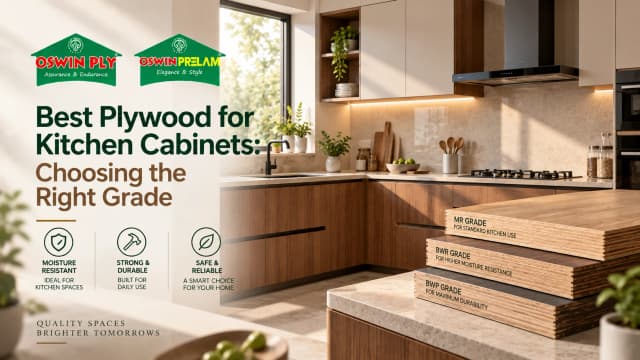
In kitchens and bathrooms, the finish is only part of the protection. Choose a moisture grade of plywood for wet zones, seal all cut edges, and use a wipe-clean finish. Best Plywood for Kitchen Cabinets: Choosing the Right Grade sets out the grades zone by zone.
Choose paint when you want a solid colour and a surface that can be touched up easily. Choose polish when the grain is the feature, as on a teak or birch face. Choose laminate when the surface must take heavy daily use, as in a kitchen or on a worktop. If you are unsure, ask where the piece will sit, who will use it and how often it will be cleaned. The answers usually point to the right finish.
Work in a well-ventilated space, and wear a mask and gloves when you sand or spray. Keep solvent-based finishes away from flames and sparks. Rags soaked in some oil-based finishes can heat up as they dry, so lay them flat to dry outdoors, or follow the safety advice on the product label.
Oswin Ply makes plywood, block board, flush doors and prelam particle board, and sells them through authorised dealers. Your dealer can tell you the grade of each board, so you can match the finish to the wood and the room.
Sand the surface, fill gaps, seal the edges, apply a primer, then two thin coats of paint, with a light sand between coats.
Yes. Primer evens out how the wood absorbs paint, helps the paint stick and reduces blotchiness.
Start at about 120 grit and finish at 180 to 220, sanding along the grain with light pressure.
Seal the sanded face, apply thin coats of clear PU or melamine polish, rubbing lightly between coats, and finish with a matte or gloss coat.
It is not recommended. Without sanding and priming, paint is more likely to peel and show the grain unevenly.
Thin white paint with roughly equal parts water, brush it on, wipe it back while wet, and seal it with a clear top coat.
A washable enamel on a sealed, primed surface, over a moisture grade of plywood with sealed edges.
Usually a primer coat and two thin coats of paint. Let each coat dry fully, and sand lightly between coats.
Not always. Veneer faces suit clear polish, painted surfaces need a primer, and floors need a harder top coat than furniture.
Oswin Wood Panels manufactures ISI-certified plywood, block board, flush doors and Prelam boards from Chennai. Find your nearest Oswin Ply dealer and name the board, grade and thickness you want.
Call 044 2669 0023.
Written by Mr. Balakrishna Iyer, GM – Sales (Tamil Nadu), Oswin Ply (Oswin Wood Panels Pvt. Ltd), a Chennai-based plywood and block board manufacturer. We manufacture ISI-certified BWP plywood, marine plywood, flush doors, block boards and Prelam boards, including HDHMR-core options, supplying dealers across Tamil Nadu, Karnataka, Andhra Pradesh, Telangana, Maharashtra and Goa.