

Search “waterproof plywood” and you will find dozens of listings using the word freely. Ask what standard certifies a board as waterproof, and the answer gets vague fast, because no such certification exists, and understanding why is worth more to a buyer than any single grade recommendation.
No. Plywood is wood, and wood is not literally waterproof, no board survives indefinite submersion undamaged. What the market calls “waterproof plywood” is almost always BWP grade (IS 710, Boiling Water Proof), which is tested to survive prolonged boiling-water exposure without delaminating. That is a genuinely strong, real property. It is not the same as the word “waterproof” implies, and the gap between the two is exactly where buyers get misled, sometimes by marketing, sometimes just by the loose way the word gets used at the dealer counter.
No Indian Standard certifies a board as absolutely waterproof, because no wood-based panel can be. Wood is a porous, cellular material, and even the strongest resin bond cannot change the fundamental nature of the fibres themselves. What manufacturers can genuinely build, and what IS 710 actually tests for, is resistance to prolonged exposure to boiling water without the glue bond failing. That is where the name Boiling Water Proof comes from, and it is a real, meaningful, testable property. “Waterproof” is the market’s shorthand for it, applied more loosely than the underlying standard actually supports.
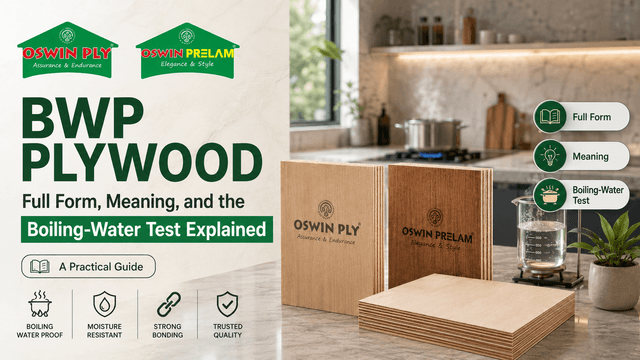
BWP grade plywood is bonded with phenol-formaldehyde resin and tested to withstand prolonged boiling-water exposure without the plies separating. That makes it the strongest genuinely certified moisture performance available in plywood, and the honest baseline for anything marketed as “waterproof.” It is excellent for kitchens, exteriors, and sustained moisture exposure. It will still eventually fail under permanent submersion, the same as any wood-based material, the standard certifies resistance under a defined, rigorous test, not immunity under all conditions indefinitely.
Wood fibre is naturally porous at a cellular level, which is part of what makes it lightweight and workable in the first place. Resin bonding seals the glue lines between plies and can coat the surface, but it cannot fully eliminate the fibre’s underlying porosity. Given enough time and enough water, moisture will eventually find a path in, at a cut edge, through a fastener hole, or through microscopic gaps the resin did not fully seal. A genuinely waterproof material would need to not be a cellular, fibrous structure at all, which is a different category of material entirely from wood-based panels.
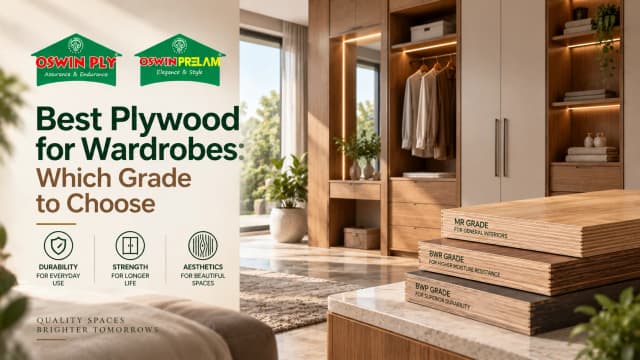
| Grade | IS standard | What it actually handles |
|---|---|---|
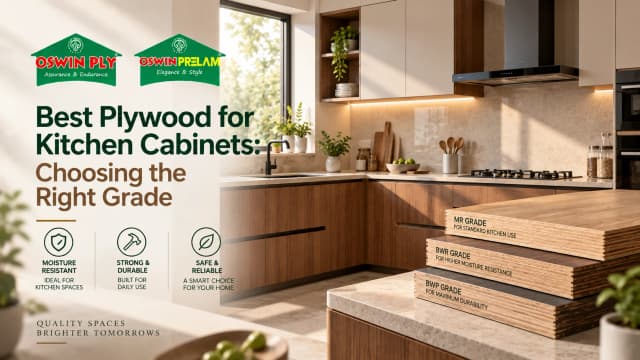
| MR | IS 303 | Everyday humidity, occasional light splash |
| BWP | IS 710 | Sustained exposure, boiling-water tested |
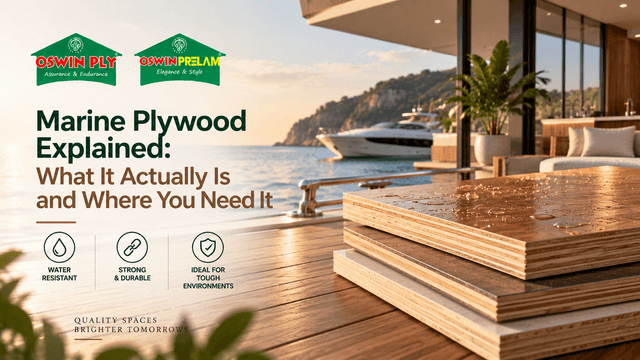
| Marine | IS 710, tighter QC | The most sustained exposure plywood can handle, still not permanently submersion-proof |
For the full grade ladder and how each tier is specified and tested, see our complete guide to Plywood Grades, Types and Uses.
The term persists because it sells, and because for most buyers, the practical difference between “highly water-resistant” and “waterproof” rarely gets tested in daily use. A BWP kitchen cabinet that never sees standing water performs identically whether it’s marketed as waterproof or moisture-resistant. The distinction matters most in the edge cases, sustained leaks, flooding, permanent water contact, where the honest specification, not the marketing word, determines whether the board survives. Some sellers use the word carelessly rather than deceptively, but the effect on a buyer’s expectations is the same either way.
A genuinely well-made BWP sheet exposed to splashing or occasional standing water shows no meaningful change, that is exactly what the grade is built for. Left in prolonged standing water for weeks or months, even BWP grade will eventually show swelling at the edges and, over a much longer period, some softening at the point of continuous saturation. This is not a manufacturing failure, it is the physical limit of any wood-based material under conditions no plywood grade is rated for. The practical lesson is that grade selection reduces risk within realistic use, it does not remove the need for good installation, proper edge sealing, and basic maintenance.
It is worth understanding why wood-based panels sit where they do on the waterproofing spectrum. Materials like solid PVC, certain sealed composites, and metal are genuinely waterproof in the literal sense, because they are not built from porous, fibrous cellular structures the way wood is. Plywood, MDF, and particle board all share the same fundamental limitation regardless of grade, they are engineered from wood fibre, and wood fibre’s porosity is the property resin bonding manages rather than eliminates. This is not a shortcoming specific to any one brand or grade, it is a property of the underlying material category, and understanding that helps set realistic expectations before comparing plywood against a genuinely different type of material for a wet-area application.
When a listing or a dealer describes a board simply as waterproof with no further detail, that absence of detail is itself informative. A seller confident in a genuine IS 710 boiling-water tested product typically leads with the standard number, since it is a real, checkable credential that supports the sale. A vaguer waterproof claim with no standard attached is not necessarily false, but it has not been substantiated in a way you can verify, and the appropriate response is to ask the follow-up question directly rather than accept the word at face value.
Rather than searching for a mythical waterproof board, it is more useful to match the grade to the actual exposure level the furniture will realistically face. Occasional humidity with no direct water contact calls for MR grade. Regular splash and moisture, kitchens, most bathroom furniture, calls for BWP. Sustained or repeated direct water exposure, docks, commercial kitchen wet zones, coastal exterior-adjacent fittings, calls for marine grade. None of the three promise the impossible, each is honestly built for a defined level of real-world exposure, and choosing correctly among them delivers far better results than chasing a word the market uses more loosely than any certified standard actually supports.
This same honest approach applies to another over-claimed plywood property, see our companion guide to termite-resistant plywood for what that term genuinely covers and what it doesn’t.
It is highly water resistant and boiling-water tested, the strongest genuinely certified moisture performance in plywood, but not literally waterproof under permanent submersion.
Marine grade comes closest, built to the same BWP resin standard with tighter veneer quality control for sustained exposure, though even marine grade is not indefinitely submersion-proof.
BWP or marine grade, yes, that’s exactly the moisture-heavy application they’re built for. Just don’t expect literal indestructibility under standing water.
You’re paying for the phenol-formaldehyde resin bonding and the manufacturing quality control that genuinely holds up under boiling-water testing, not for a marketing word.
Surface sealants improve water resistance at the treated surface but do not change the underlying board’s grade or make an MR sheet perform like BWP, the core specification still matters most.
Brief flooding that is dried out promptly typically causes limited damage to a genuine BWP sheet, prolonged standing water over days or weeks will eventually cause edge swelling regardless of grade, prompt drying is the best mitigation in any flood scenario.
Oswin Wood Panels manufactures ISI-certified BWP (IS 710) and marine grade plywood, the honest baseline for anything marketed as “waterproof,” from Chennai. Tell us the real exposure level and we’ll match the grade to it.
Call 044 2669 0023 or find your nearest Oswin dealer.
Written by Mr. Balakrishna Iyer, GM – Sales (Tamil Nadu), Oswin Ply (Oswin Wood Panels Pvt. Ltd), a Chennai-based plywood and block board manufacturer. We manufacture ISI-certified BWP plywood, marine plywood, flush doors, block boards and Prelam boards, including HDHMR-core options, supplying dealers across Tamil Nadu, Karnataka, Andhra Pradesh, Telangana, Maharashtra and Goa.