

Plywood is better known for furniture than for floors, but it is used underfoot more often than most people realise. It sits under tiles and wooden floors, forms the surface of raised platforms and mezzanines, lines the floors of trucks and trailers, and in some homes it is the visible floor itself, finished in a pale, whitewashed look.
This guide explains where plywood works as flooring and roofing, what checked plywood and checkered plywood are, which grade and thickness to ask for, and the limits that keep a plywood floor safe.
Plywood works as a floor where it is supported well and protected from moisture. Use it as a subfloor, as a platform surface, or as a finished floor on joists, and choose a moisture grade where there is any chance of damp. Chequered plywood, also called checkered or checked plywood, is a patterned, non-slip board used mainly for vehicle floors, ramps and loading platforms. For any floor that carries people or loads, have the support checked by a qualified person.
A plywood floor is only as strong as what is under it. The board spans the gaps between joists or supports, and the spacing of those supports decides the thickness you need. As a rule, the thicker the board, the wider the supports can be, and a heavier load needs closer supports.
| Use | Typical thickness | Grade |
|---|---|---|
| Subfloor under tiles or wood | 18 mm or more, on closely spaced supports | Moisture grade in damp areas, MR in dry rooms |
| Loft or storage platform | 18 to 25 mm | MR in a dry loft |
| Raised stage or mezzanine | 25 mm, on a designed frame | Chosen by the designer |
| Exhibition or temporary floor | 18 mm | Commercial grade is often enough |
These are general guides. For any floor that carries people, furniture or equipment, get the frame and the board thickness confirmed by an engineer or the designer. Plywood Thickness in mm: 6 mm, 12 mm, 18 mm and 19 mm Plywood Compared explains how thickness relates to span.
A wooden flooring sheet is a large panel that is laid on a frame or a subfloor and fixed down. Plywood flooring sheets suit places where a floor needs to be fitted quickly, such as stages, exhibition stands and temporary spaces, and they are fixed with the length of the sheet running across the supports. Ply flooring in a home is usually laid over joists, with the joints between sheets staggered so that they do not line up, and a small gap left at the walls for movement.
White plywood floors are a pale, airy look made by sanding the plywood smooth and then finishing it with a white stain, a whitewash or a pale paint. A hard-wearing clear top coat is essential, because a floor takes far more wear than a wall. Choose a board with a clean face, seal every edge, and expect to recoat the top layer from time to time. How to Paint, Polish and Finish Plywood: A Step-by-Step Guide covers whitewash and white stain.
Checkered plywood is also written as chequered plywood, and sold as checked plywood. It is plywood with a raised grid or check pattern on its surface, which gives grip. The pattern is what makes it different from a plain board, and it is why this type is chosen where people or loads move across a floor.
Truck flooring plywood is a tough board used for the floor of trucks, trailers and containers. It needs to resist heavy loads, scuffing and moisture, so it is usually a moisture grade with a hard surface, sometimes in a checkered pattern. Thickness depends on the vehicle and the load, so follow the vehicle maker's guidance.
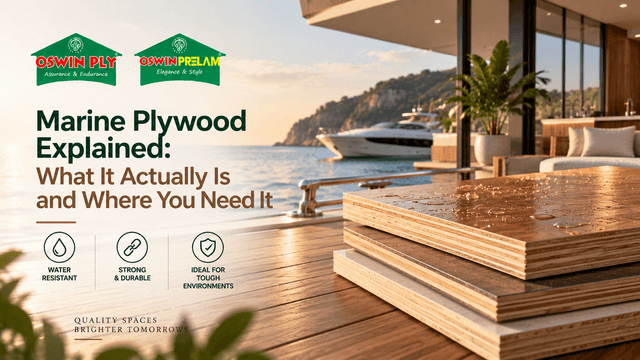
Roofing plywood is used as a base under the roof covering in sheds, extensions and light structures. Roof boards of this kind must be a water-resistant grade, with sealed edges, because they sit above a space that must stay dry. Cover the board promptly with the final roof layer, and do not leave it exposed. These boards are for light structures, and a full roof design should always be checked by a qualified person. For this kind of work, ask your dealer about BWP or marine grade. Marine Plywood Explained: What It Actually Is and Where You Need It explains the highest moisture grade.
Moisture is the main enemy of a plywood floor. Never lay plywood directly onto a damp slab, and make sure any space under a raised floor is ventilated. Choose a moisture grade where damp is a risk, seal the underside and the edges, and fix any leak before the board goes down. A floor that stays dry will last far longer than one that is only protected on top.
A finished plywood floor needs a hard-wearing clear coat. Sand it smooth, seal it, and apply several thin coats, letting each dry fully. Sweep or vacuum regularly, wipe up spills at once, and use felt pads under furniture. Recoat the top layer when the finish begins to wear. A floor in a busy area will need this more often than one in a quiet room.
Oswin Ply makes plywood, block board, flush doors and prelam particle board, and sells them through authorised dealers. Flooring and vehicle boards are specialised products, so tell your dealer the use, the load and the exposure, and ask which of the available boards suits it.
It is plywood with a raised grid pattern on the surface for grip. It is used for vehicle floors, ramps and loading platforms.
Yes, as a subfloor, a platform surface or a finished floor, if it is well supported, sealed and protected from moisture.
Commonly 18 mm or more, on closely spaced supports. Confirm the thickness with the designer for your span and load.
It is a tough, usually moisture-grade board used for the floors of trucks, trailers and containers, sometimes with a checkered surface.
Yes, as a base under the roof covering, in a water-resistant grade with sealed edges, and covered promptly.
They can be, with a clean board, a sealed surface and a hard-wearing clear top coat. Expect to refresh the top coat over time.
Fix the sheets firmly to every support with screws at an even spacing, and make sure the supports are level and dry. Squeaks usually come from movement between the board and the frame.
Oswin Wood Panels manufactures ISI-certified plywood, block board, flush doors and Prelam boards from Chennai. Find your nearest Oswin Ply dealer and name the board, grade and thickness you want.
Call 044 2669 0023.
Written by Mr. Balakrishna Iyer, GM – Sales (Tamil Nadu), Oswin Ply (Oswin Wood Panels Pvt. Ltd), a Chennai-based plywood and block board manufacturer. We manufacture ISI-certified BWP plywood, marine plywood, flush doors, block boards and Prelam boards, including HDHMR-core options, supplying dealers across Tamil Nadu, Karnataka, Andhra Pradesh, Telangana, Maharashtra and Goa.