

Ask a carpenter which plywood to use and the first answer is often a number: 18 mm for the carcass, 6 mm for the back, 12 mm for the drawers. Plywood thickness in mm is the single detail that decides whether a piece sags, bows or lasts, yet many buyers order by grade alone.
This guide compares 6 mm, 12 mm, 18 mm and 19 mm plywood, with the job each one suits, where it falls short, and how to check the thickness you are actually given.
Use 6 mm plywood for backs and light panelling, 9 to 12 mm for partitions, drawer bases and short shelves, 18 mm for carcasses, shutters and most furniture, and 19 mm where you want a little extra strength. Use 25 mm for heavy shelves and table tops. The rule of thumb is simple: thicker for more load, thinner for backs and covers.
| Thickness | Best for | Avoid for |
|---|---|---|
| 6 mm | Cabinet backs, drawer bottoms, light panelling | Anything that carries weight |
| 12 mm | Partitions, drawer sides, short shelves | Long unsupported shelves |
| 18 mm | Carcasses, shutters, most furniture | Very long spans with no support |
| 19 mm | Same as 18 mm, with a little more strength | Mixing with 18 mm in one unit |
| 25 mm | Heavy shelves and table tops | Light backs and covers |
6mm plywood, also sold as 6 mm ply, is the thin sheet used for the back of a cabinet or wardrobe, the base of a drawer and light panelling. A back panel keeps the unit square, so it is worth fitting even though nobody sees it. It is not meant to carry weight, so do not use it for shelves or shutters.
12mm plywood suits partitions, drawer sides and short shelves. Keep shelf spans short, because a 12 mm shelf bends under a long load of books or crockery. For wall panels and partitions, see Plywood Wall Design Ideas: Panelling, Partitions and Ceilings.
18mm plywood, or 18mm ply, is the workhorse thickness for furniture. It is strong enough for wardrobe and kitchen carcasses, shelves, shutters and table tops on a frame. As a rule, keep shelf spans under about 900 mm for 18 mm board, or add a vertical divider.
Plywood Wardrobe Design Ideas: Layouts, Shutters and Internal Fittings and Best Plywood for Kitchen Cabinets: Choosing the Right Grade show where 18 mm goes in a wardrobe and a kitchen.
19mm plywood, also written 19 mm ply, is close to 18 mm and is used in the same places. The difference is small, so choose the thickness your dealer can supply consistently. Do not mix 18 mm and 19 mm boards in one unit, because the step shows on exposed edges and in joinery.
Thickness and grade are separate choices. Thickness decides how much load a board can carry, and grade decides how it handles moisture. A thicker MR board is no better in a wet area, and a thinner BWP board is still a moisture grade. Types of Plywood: Grades, Faces and Uses explains the grades.
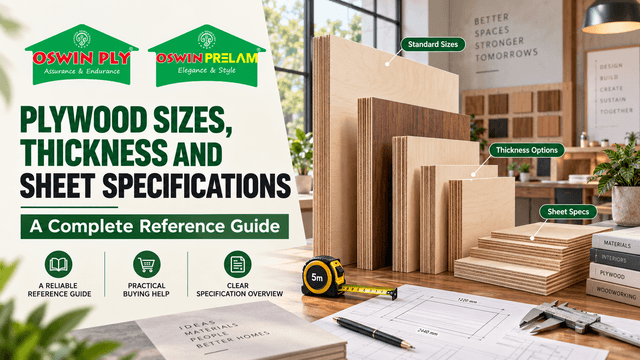
The full sheet and thickness reference is in Plywood Sizes, Thickness and Sheet Specifications, and Plywood Board, Plyboard and Plywood Sheets: Are They the Same? explains how boards are named.
| Piece | Main panel | Back or secondary |
|---|---|---|
| Wardrobe | 18 mm | 6 to 9 mm back |
| Kitchen cabinet | 18 mm | 6 to 9 mm back |
| Bed box and headboard | 18 mm | Not needed |
| TV unit | 18 mm | 6 to 9 mm back |
| Study table | 18 mm top | 12 mm drawer sides |
| Dining table top | 25 mm, or 18 mm on a frame | Not needed |
| Bookshelf | 18 mm, with spans under about 900 mm | 6 mm back |
| Shoe rack | 12 to 18 mm | 6 mm back |
Between the common thicknesses are two more that you will meet. 9 mm plywood suits drawer bases, partitions and lightly loaded panels, and is a step up from a 6 mm back. 15 mm or 16 mm plywood is used by some carpenters for shutters and shelves where 18 mm is more than the job needs. Both are less common, so check availability with your dealer, and avoid mixing them with 18 mm boards in one unit.
At 25 mm, plywood is used for table tops, heavy shelves and workshop benches. It is heavy, so it needs strong joinery and hardware, and the sheet is harder to cut and move. For a dining table, an 18 mm top on a frame often gives the same stiffness with less weight.
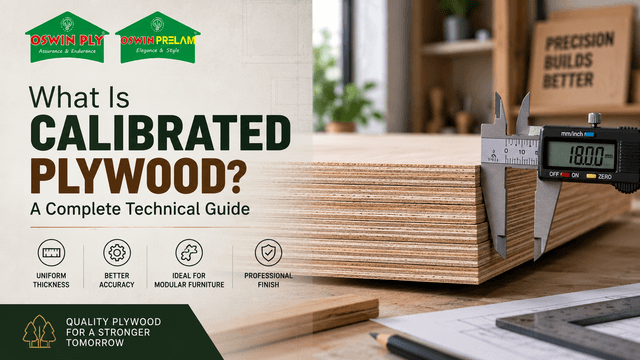
A board sold as 18 mm may measure slightly more or less, because of how it is made and finished. A small difference within the maker's tolerance is normal. A large shortfall is not. Ask your dealer what tolerance the brand works to, measure at several points on the edge, and compare sheets from the same stack. Sheets from different batches can differ, which is another reason not to mix boards in one unit.
Thicker plywood is heavier, and weight matters for hanging cabinets, wall-mounted units and sliding shutters. A heavier board puts more load on hinges, tracks and wall fixings, so do not specify more thickness than the job needs. For a wall-mounted unit, check that the wall and the fixings can carry the loaded weight, not only the empty unit.
Oswin Ply makes plywood, block board, flush doors and prelam particle board, and sells them through authorised dealers. When you order, name the grade, the thickness in mm and the size, and ask to see the marking on the sheet.
18 mm is the most common thickness for furniture carcasses, shelves and shutters. 6 mm is used for backs, and 12 mm for partitions and drawers.
Yes. Eighteen millimetre board is the usual thickness for wardrobe carcasses and shutters. Keep shelf spans under about 900 mm, or add a divider.
It is slightly stronger, but the difference is small. Choose the one your dealer supplies consistently, and do not mix the two in one unit.
Cabinet backs, drawer bottoms and light panelling. It is not meant to carry weight.
Only for short spans. For long shelves, use 18 mm or add support.
Use a caliper at several points along the edge. Check every sheet, because thickness can vary between sheets.
Eighteen millimetre board for the carcass and shelves, with a 6 to 9 mm back panel.
Eighteen millimetres for most shelves, with the span kept under about 900 mm. Use 12 mm only for short, lightly loaded shelves.
Oswin Wood Panels manufactures ISI-certified plywood, block board, flush doors and Prelam boards from Chennai. Find your nearest Oswin Ply dealer and name the board, grade and thickness you want.
Call 044 2669 0023.
Written by Mr. Balakrishna Iyer, GM – Sales (Tamil Nadu), Oswin Ply (Oswin Wood Panels Pvt. Ltd), a Chennai-based plywood and block board manufacturer. We manufacture ISI-certified BWP plywood, marine plywood, flush doors, block boards and Prelam boards, including HDHMR-core options, supplying dealers across Tamil Nadu, Karnataka, Andhra Pradesh, Telangana, Maharashtra and Goa.