

A plain plywood board is a blank canvas. What turns it into a feature wall, a warm kitchen or a calm bedroom is the surface: its texture, its colour and the finish on top. Searches for texture plywood, decorative plywood and plywood colours keep growing, because more homeowners want the look of wood without the weight and upkeep of solid timber.
This guide explains how plywood gets its texture and colour, which surfaces suit a bedroom, a living room and a kitchen, and how to plan a plywood interior that stays easy to live with.
Texture plywood is not one product. It is any board whose surface has been given a feel or a pattern, and there are five common routes.
Plywood colours come from four sources. The first is the wood itself: teak is golden, birch is pale and pine is light yellow. The second is stain, which colours the grain and lets it show. The third is paint, for solid colours. The fourth is a laminate or veneer bonded to the face. Plywood sheet colours therefore range from pale cream to deep brown in natural woods, and almost any shade in painted or laminated boards. Colored plywood, meaning a board with a painted or stained face, is popular for kids' rooms and shelves. When you ask for a ply colour, say which of the four you mean, because they behave very differently. How to Paint, Polish and Finish Plywood: A Step-by-Step Guide covers paint, polish and stain in detail.
| Type | What it is | Where it works |
|---|---|---|
| Veneered plywood | A thin wood veneer on the face | Wall panels, wardrobe shutters, furniture fronts |
| Laminated plywood | A decorative laminate bonded to the face | Kitchens, wardrobes, desks |
| Grooved plywood | Lines cut into the face | Feature walls, headboards, TV panels |
| Painted or stained plywood | A coloured finish on the wood | Shelves, kids' rooms, accent pieces |
Decor plywood is a general label for any of these. It tells you about the face, not about the grade underneath, so ask for the grade as well.
| Room | Colours that work | Texture idea |
|---|---|---|
| Bedroom | Warm wood tones, soft neutrals | Fluted headboard panel |
| Living room | Natural wood with one darker accent | Grooved TV wall or slatted divider |
| Kitchen | Light woods, white, soft greys | Plain or lightly textured shutters |
| Kids' room | Light, cheerful shades | Smooth, wipe-clean surfaces |
| Study | Calm, mid-tone woods | Plain panels with open shelves |
A calm bedroom needs fewer surfaces, not more. A plywood design for a bedroom usually starts with the headboard wall: a fluted or grooved panel in a warm wood tone, with side niches for lights and a small shelf for a phone and a book. Keep the wardrobe in a matte wood grain or a soft neutral, so that the headboard stays the feature. Dark colours work best as accents, such as a bedside panel or a frame, rather than on every surface.
Plywood interior design in a living room often means one strong wall. A grooved TV panel, a slatted divider between the living and dining areas or a set of open niches with a wood-grain back gives the room a focus without clutter. Use plywood interior elements in two or three places, such as the TV wall, a divider and a shelf, and repeat the same wood tone so they read as one design. Plywood Wall Design Ideas: Panelling, Partitions and Ceilings covers the fixing and the planning.
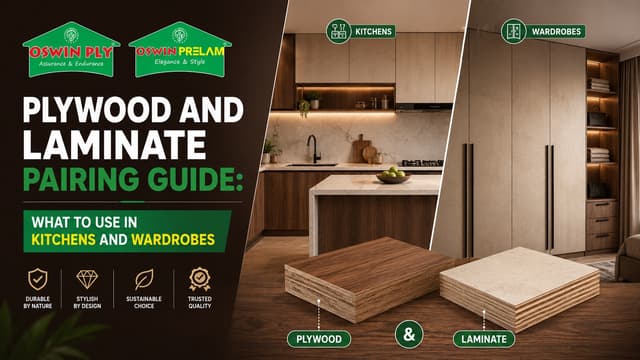
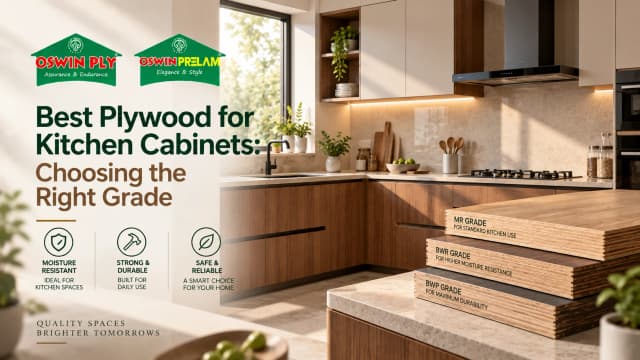
Kitchen plywood colours should work hard. Light woods, whites and soft greys make a small kitchen feel larger and hide less. Dark and high-gloss shutters look dramatic but show fingerprints and water marks, so choose a matte finish if you do not want to wipe them every day. A good kitchen ply design pairs a wood grain on the tall units with a plain colour on the base units. Whatever you choose, use a moisture grade of plywood in wet zones. Plywood and Laminate Pairing Guide: What to Use in Kitchens and Wardrobes sets out the zones.
When you order for plywood home decor work, name five things: the grade, the thickness, the face type, the colour or finish, and the sheet size. Ask for a sample of the exact finish, and ask whether edge banding is available in a matching colour. Order all the sheets for one wall or one run of furniture together, so the colour matches.
Grooves are cut into the face of a board, so the board must be thick enough to take them. For fluted wall panels, a board of about 12 to 18 mm is common, because a thin sheet can be cut through. Decide the groove width and spacing before the cutting starts, and finish the panel after it has been grooved, so that the grooves are sealed too. Grooves collect dust, so keep deep grooves out of kitchens and places that are hard to wipe.
Light changes how texture looks. Light that skims across a surface from the side picks out grooves and grain and gives depth, while straight downlights flatten it. Gloss finishes can create glare, so avoid pointing bright lights straight at them. Place a strip light along the side of a grooved wall, and check how a sample looks at different times of day before you decide.
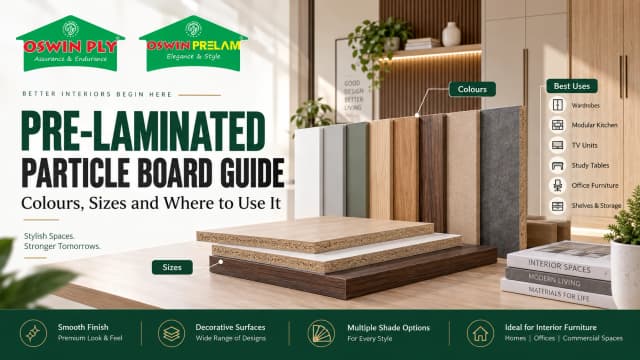
Oswin Ply makes plywood and prelam particle board, and sells them through authorised dealers, so finished boards are an option when you want the colour and texture already on the surface. Pre-Laminated Particle Board Guide: Colours, Sizes and Where to Use It sets out the range.
It is plywood with a surface that has a feel or a pattern, such as natural grain, a brushed finish, grooves or an embossed laminate.
Plywood takes its colour from the wood, a stain, paint, or a laminate or veneer on the face. Natural wood tones range from pale birch to golden teak.
No. Decorative describes the face. The moisture grade, such as MR, BWR or BWP, is a separate choice.
Light woods, white and soft greys suit most kitchens. Choose a matte finish if you do not want to see every fingerprint.
Dust with a soft brush, and wipe laminate with a damp cloth. Wipe veneer only lightly, and dry it afterwards.
A fluted or grooved headboard panel in a warm wood tone, with a matte wardrobe, works for most bedrooms.
Yes. Paint, stain and laminate all give a wide range of colours. Ask for a sample of the exact finish before you order.
Commonly about 12 to 18 mm, so that the grooves do not cut through the face. Confirm the groove depth with your carpenter.
Oswin Wood Panels manufactures ISI-certified plywood, block board, flush doors and Prelam boards from Chennai. Find your nearest Oswin Ply dealer and name the board, grade and thickness you want.
Call 044 2669 0023.
Written by Mr. Balakrishna Iyer, GM – Sales (Tamil Nadu), Oswin Ply (Oswin Wood Panels Pvt. Ltd), a Chennai-based plywood and block board manufacturer. We manufacture ISI-certified BWP plywood, marine plywood, flush doors, block boards and Prelam boards, including HDHMR-core options, supplying dealers across Tamil Nadu, Karnataka, Andhra Pradesh, Telangana, Maharashtra and Goa.