

BWR plywood is one of the most asked-about grades and one of the least clearly explained. Dealers use the name for boards that sit between ordinary MR plywood and full BWP plywood, but not every maker uses it in exactly the same way.
This guide explains what BWR stands for, where it fits between MR and BWP, where it works well and where it does not, and what to ask before you buy.
BWR stands for Boiling Water Resistant. A BWR board is meant to resist occasional moisture better than MR plywood, but it is not built for constant water contact. It suits kitchens away from the sink, utility areas and wardrobes in humid homes. Where a board will meet water every day, BWP or marine grade is the safer choice. Because makers do not all define BWR in the same way, ask for the adhesive and the test behind the grade.
BWR is short for Boiling Water Resistant. A boiling water resistant plywood board is one built to stay bonded after exposure to hot water, which a boiling water test checks. A board that holds together is a better match for humid conditions than a plain MR board.
The key word is resistant. It means the board copes with moisture for a limited time. It does not mean water cannot affect it.
| Grade | What it is built for | Typical use |
|---|---|---|
| MR | Dry rooms and occasional dampness | Wardrobes, shelves, study tables |
| BWR | Occasional moisture and humidity | Upper kitchen units, utility areas |
| BWP | Prolonged moisture and water contact | Under-sink units, bathroom vanities |
| Marine | The highest moisture grade | Boards facing sustained water exposure |
Each grade has its own guide: MR Plywood Full Form and Meaning: The Complete Guide, BWP Plywood Full Form, Meaning and the Boiling-Water Test Explained and Marine Plywood Explained: What It Actually Is and Where You Need It.
MR and BWP are described fairly precisely in trade practice. BWR is used more loosely. One maker may sell a board as BWR because it has a better adhesive than MR and passes a short boiling test. Another may use the name for a board that is only slightly better than MR. So the name alone does not tell you how a board will behave in your kitchen.
Four questions get you a real answer.
You will also see the term moisture resistant plywood. This usually means MR grade, which handles dampness in dry, everyday use. BWR sits one step above it. If a label says only moisture resistant, ask which grade the board really is.
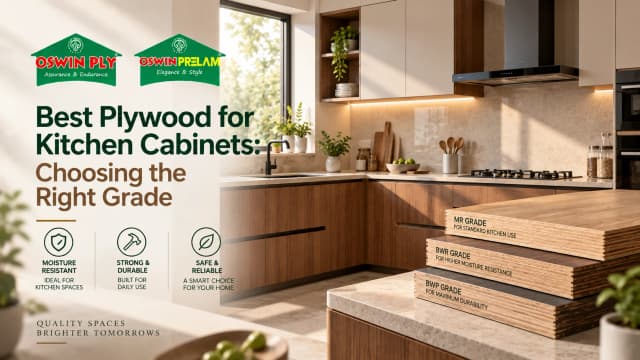
Use BWP or marine grade in these places. Best Plywood for Kitchen Cabinets: Choosing the Right Grade sets out the kitchen zone by zone.
The word boiling in BWR points to a simple idea. A sample cut from the board is kept in boiling water for a set period, then checked to see whether the layers have separated or the bond has weakened. A board that stays bonded passes. The longer and harder the test, the more demanding the grade.
The exact test, its duration and its pass mark depend on the standard a maker follows, and not every maker follows the same one for BWR. That is why you should ask for the test behind the label, and not only the label. The same question is useful for BWP, which sits at the demanding end of the range. BWP Plywood Full Form, Meaning and the Boiling-Water Test Explained covers that test in more detail.
A kitchen is not one environment. Steam, splashes and standing water are concentrated in a few places, and the grade can follow them.
| Zone | Moisture exposure | Suggested grade |
|---|---|---|
| Upper cabinets away from the hob | Steam and humidity | BWR |
| Tall units and pantry | Low | MR or BWR |
| Base units away from the sink | Occasional splash | BWR |
| Under-sink and dishwasher side | Frequent water | BWP or marine |
| Breakfast counter carcass | Low | MR or BWR |
In a coastal or very humid home, move each zone up one step. Best Plywood for Kitchen Cabinets: Choosing the Right Grade goes through the kitchen in full.
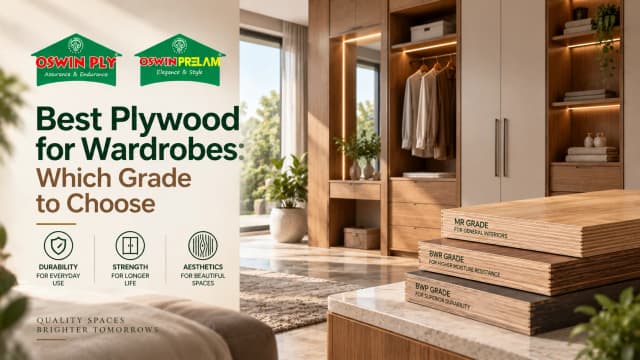
Wardrobes are normally a dry-room product, so MR grade is enough in most homes. In coastal cities, in ground-floor rooms and in rooms with little ventilation, the air stays damp for much of the year, and BWR gives a margin of safety for the carcass and shelves. Dining and study furniture sit in the same position. The board is not under water, but it is exposed to humidity all year, and that is the situation BWR is meant for.
Marine plywood sits above BWP at the top of the moisture grades, with tighter veneers and fewer core gaps, and it is built for sustained water exposure. BWR sits well below that. If a project involves constant water contact, BWR is the wrong starting point, and Marine Plywood Explained: What It Actually Is and Where You Need It explains where marine grade belongs.
Not every project needs BWR. In a dry, well-ventilated room on an upper floor, MR grade does the job, and choosing BWR adds nothing. The aim is to match the grade to the real conditions of the room, not to choose the highest grade on the shelf. If you are unsure how damp a space really is, look for signs such as peeling paint, a musty smell or condensation on windows, and choose BWR where you see them.
Oswin Ply makes plywood, block board, flush doors and prelam particle board, and sells them through authorised dealers. Ask your dealer which grade fits each zone of your project, and ask to see the marking on the sheet.
BWR stands for Boiling Water Resistant.
It resists occasional moisture better than MR plywood, but it is not made for constant water contact. For wet zones, use BWP or marine grade.
BWR is built to resist occasional moisture. BWP uses a stronger bonding resin and is built for prolonged moisture exposure, so it is the better match for wet areas.
Yes for upper units and dry sections. For the sink zone and for base units near water, use BWP or marine grade.
Not always. Moisture resistant usually means MR grade, which is a step below BWR. Ask which grade the board really is.
Look for the grade marking on the sheet, ask the dealer for the adhesive and the test behind it, and buy from an authorised dealer.
A sample is held in boiling water for a set period and then checked for separation of the layers. The duration and the pass mark depend on the standard the maker follows, so ask which test the board is based on.
It is not recommended. A sink zone sees frequent water, and BWP or marine grade is the safer choice there.
Oswin Wood Panels manufactures ISI-certified plywood, block board, flush doors and Prelam boards from Chennai. Find your nearest Oswin Ply dealer and name the board, grade and thickness you want.
Call 044 2669 0023.
Written by Mr. Balakrishna Iyer, GM – Sales (Tamil Nadu), Oswin Ply (Oswin Wood Panels Pvt. Ltd), a Chennai-based plywood and block board manufacturer. We manufacture ISI-certified BWP plywood, marine plywood, flush doors, block boards and Prelam boards, including HDHMR-core options, supplying dealers across Tamil Nadu, Karnataka, Andhra Pradesh, Telangana, Maharashtra and Goa.