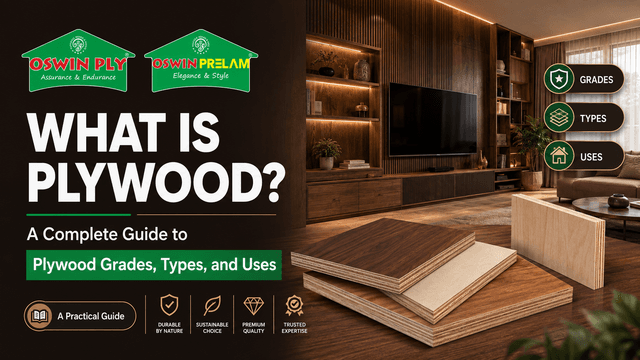


Walk into a plywood shop and you will hear a long list of names: MR, BWR, BWP, marine, commercial, film faced, veneer, laminated. They are not all the same kind of thing. Some describe how well a board handles moisture, some describe its face, and some describe where it is used.
This guide sorts the types of plywood, or types of ply as dealers often say, into three simple groups, so you can see where each name fits and choose the right one for your job.
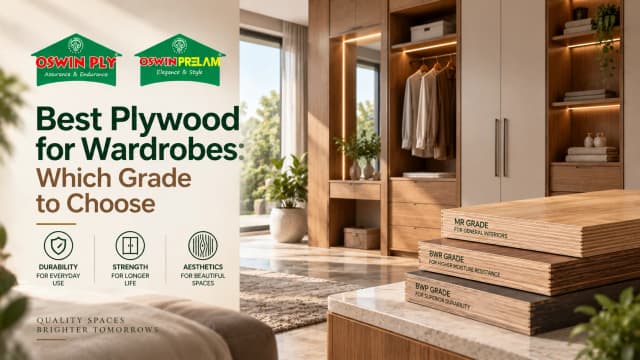
The types of plywood can be grouped in three ways. By moisture grade: MR, BWR, BWP and marine. By face and finish: veneer, laminated, film faced and plain. By use: furniture, commercial and shuttering. Choose the grade by where the board will sit, the face by how the surface should look, and the thickness by the load it must carry.
| Type | Built for | Typical use |
|---|---|---|
| MR | Dry rooms and occasional dampness | Wardrobes, shelves, study tables |
| BWR | Occasional moisture and humidity | Upper kitchen units, utility areas |
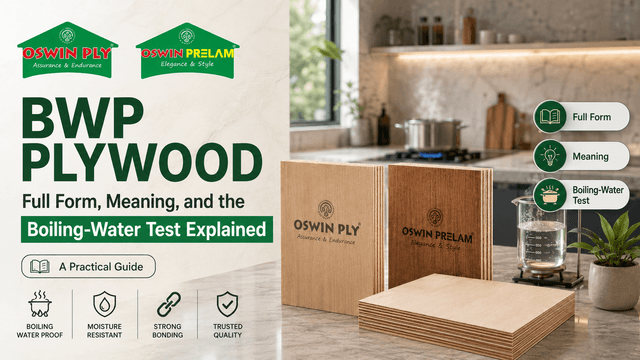
| BWP | Prolonged moisture and water contact | Under-sink units, bathroom vanities |
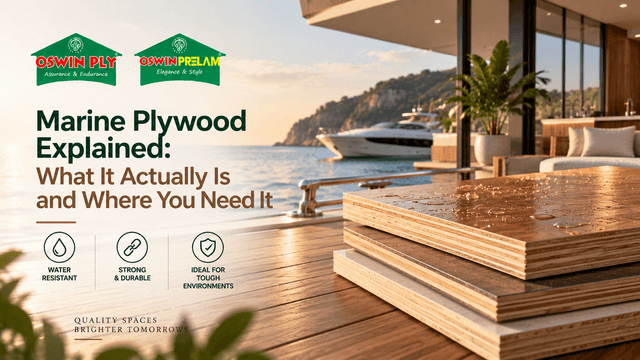
| Marine | The highest moisture grade | Boards facing sustained water exposure |
Each grade has its own guide: MR Plywood Full Form and Meaning: The Complete Guide, BWR Plywood: Meaning, Uses and Where It Fits Between MR and BWP, BWP Plywood Full Form, Meaning and the Boiling-Water Test Explained and Marine Plywood Explained: What It Actually Is and Where You Need It.
| Type | What it is | Where it is used |
|---|---|---|
| Veneer plywood | A decorative wood veneer on the face | Wall panels, wardrobe shutters, furniture faces |
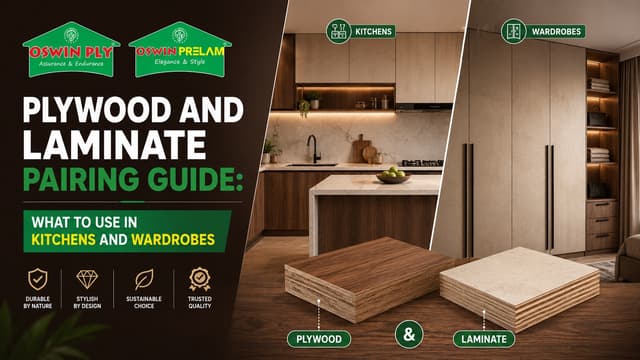
| Laminated plywood | A decorative laminate bonded to the face | Kitchens, wardrobes, desks |
| Film faced plywood | A resin film on both faces | Concrete formwork |
| Plain plywood | Bare faces, finished by the carpenter | Furniture that will be laminated or veneered on site |
Laminated Plywood: Types, Finishes and Where to Use It covers the laminated type, and Shuttering Plywood and Film Faced Plywood: What They Are and Where to Use Them covers the film faced type.
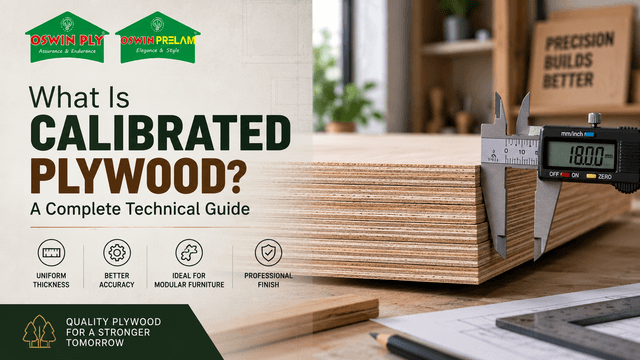
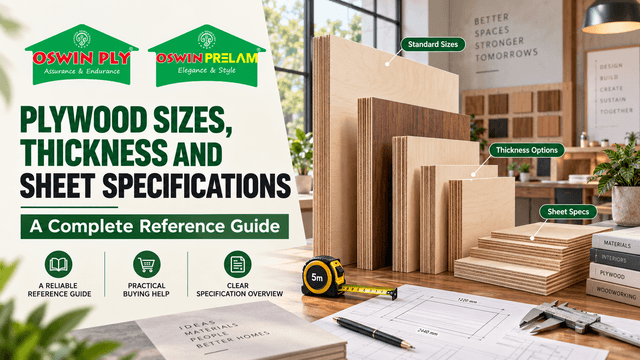
Plywood is commonly sold from about 6 mm to 25 mm, and the thickness decides what it can carry. A 6 mm sheet suits backs, 12 mm suits partitions and drawers, 18 to 19 mm suits carcasses and shutters, and 25 mm suits heavy shelves and table tops. Plywood Thickness in mm: 6 mm, 12 mm, 18 mm and 19 mm Plywood Compared explains each one.
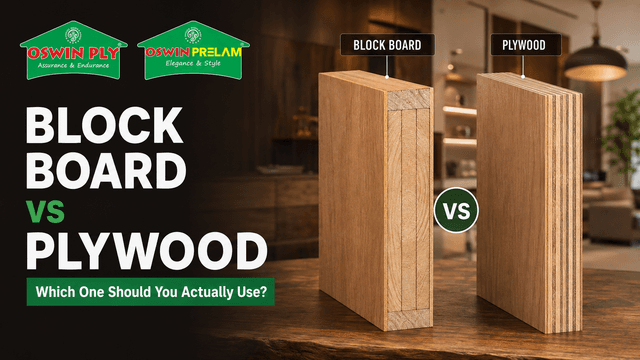
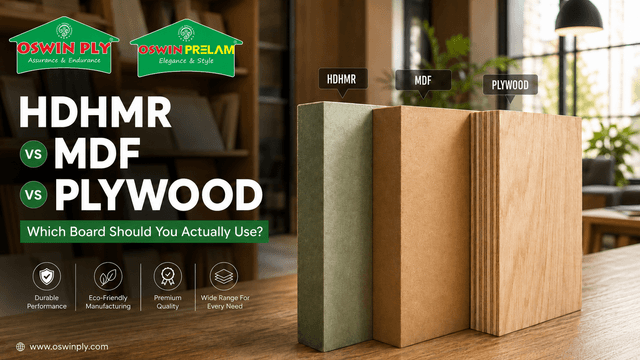
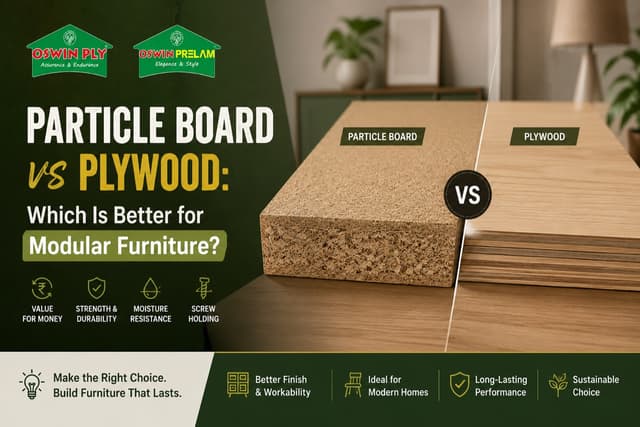
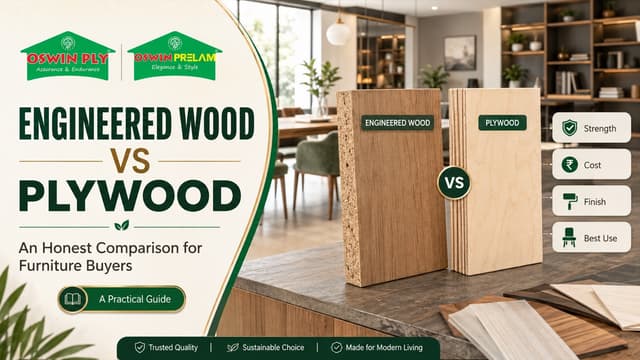
Block board, particle board and MDF are sold beside plywood, but they are different boards with different cores. Plywood Board, Plyboard and Plywood Sheets: Are They the Same? shows how to tell them apart at the shop.
| Job | Type to ask for | Thickness |
|---|---|---|
| Wardrobe in a dry room | MR grade | 18 mm |
| Upper kitchen cabinets | BWR grade | 18 mm |
| Under-sink units and vanities | BWP or marine grade | 18 mm |
| Wall panelling | MR with a veneer or laminate face | 9 to 12 mm |
| Concrete formwork | Film faced or shuttering plywood | 12 to 18 mm |
All plywood follows the same basic method. Logs are peeled into thin veneers, the veneers are dried, glued and stacked with the grain at right angles, and the stack is pressed under heat. The differences between types come from three choices made in that process.
The core is the set of layers inside, and it decides how stiff the board is and how well it holds screws.
Ask what the core is, and not only the grade. Two boards of the same grade can behave differently if their cores differ.
The adhesive is invisible in the finished board, but it is the main reason a grade behaves as it does. MR boards use an adhesive suited to dry conditions. BWR boards use a better adhesive and are built to resist occasional moisture. BWP boards use a stronger resin and are built for prolonged moisture exposure. Marine boards add tighter veneers on top of a strong bond. When a dealer names a type, ask which adhesive sits behind it.
Beyond moisture grade, plywood faces are graded by appearance. Letter grades such as A, B and C describe how clean a face is, from smooth with few defects to visible patches and knots. A pair such as BB tells you the quality of both faces. Use a clean face where it will be seen, and a lower face grade where it will be covered with laminate or hidden inside a cabinet.
Beyond the common types, you may hear of flexible plywood, which is thin plywood made to bend into curves for curved furniture and panels. You may also hear of fire-retardant plywood, which is treated to slow the spread of flame and is specified where safety rules call for it, and of decorative plywood with textured or patterned faces. These are specialised boards, and not every dealer stocks them. If your project needs one, ask early whether it is available and what its specification is.
Ask three questions in order. Where will the board sit, because that sets the moisture grade? What will it carry, because that sets the thickness and the core? What will you see, because that sets the face and the finish? Answer these three and the right type usually picks itself, whatever name the dealer uses for it.
Oswin Ply makes plywood, block board, flush doors and prelam particle board, and sells them through authorised dealers. Name the type and the grade when you speak to a dealer, and ask to see the marking on the sheet.
By moisture grade: MR, BWR, BWP and marine. By face and finish: veneer, laminated, film faced and plain. By use: furniture, commercial and shuttering plywood.
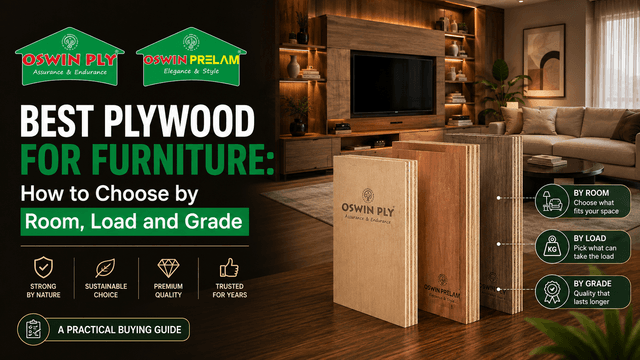
It depends on the room. MR grade suits dry rooms, and BWR or BWP suits areas near water. Best Plywood for Furniture: How to Choose by Room, Load and Grade sets it out room by room.
They are moisture grades. MR handles dry rooms, BWR resists occasional moisture, and BWP is built for prolonged moisture exposure.
BWR for upper units away from the sink, and BWP or marine grade for the sink zone and base units near water.
No. Veneer is a type of face, not a moisture grade. A veneer-faced board can be MR, BWR or BWP underneath.
Choose by the load. 6 mm for backs, 12 mm for partitions and drawers, and 18 to 19 mm for carcasses and shutters.
Face grade describes how clean the surface looks, such as A or B. Moisture grade describes how the board handles water, such as MR, BWR or BWP. They are separate choices.
It changes how the board performs. Two boards of the same moisture grade can differ in stiffness and screw holding if their cores differ.
Oswin Wood Panels manufactures ISI-certified plywood, block board, flush doors and Prelam boards from Chennai. Find your nearest Oswin Ply dealer and name the board, grade and thickness you want.
Call 044 2669 0023.
Written by Mr. Balakrishna Iyer, GM – Sales (Tamil Nadu), Oswin Ply (Oswin Wood Panels Pvt. Ltd), a Chennai-based plywood and block board manufacturer. We manufacture ISI-certified BWP plywood, marine plywood, flush doors, block boards and Prelam boards, including HDHMR-core options, supplying dealers across Tamil Nadu, Karnataka, Andhra Pradesh, Telangana, Maharashtra and Goa.