

Search for the best plywood in India and you will find long lists of names, each with a claim. But there is no single best plywood. The right board is the one whose grade matches the job and whose build is honest. A board that is perfect for a dry wardrobe is the wrong board for a sink cabinet.
This guide gives you a checklist you can use at the dealer to judge good quality plywood: what to match, what to look at and what to ask.
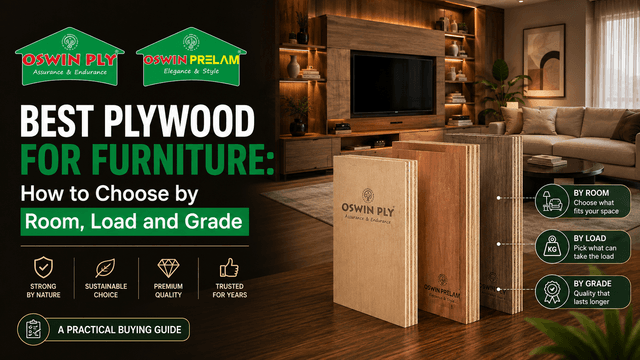
Five checks separate best quality plywood from the rest. First, the grade matches the job. Second, the core is tight, and hardwood where the piece carries load. Third, the thickness is true. Fourth, the faces and edges are clean. Fifth, the grade and brand are printed on the sheet, and the dealer can explain them.
| Where the board goes | Grade to ask for | Guide |
|---|---|---|
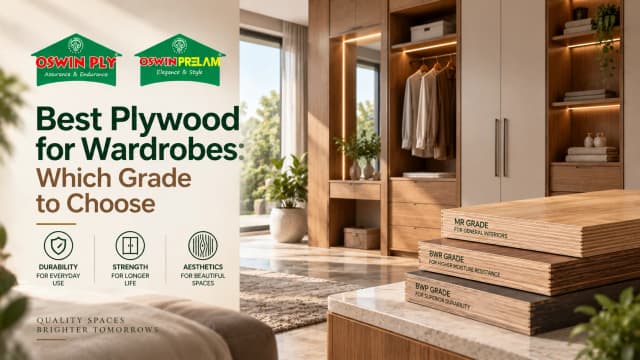
| Dry rooms: wardrobes, shelves, study tables | MR | MR Plywood Full Form and Meaning |
| Occasional moisture: upper kitchen units, utility | BWR | BWR Plywood: Meaning, Uses and Grades |
| Prolonged moisture: under-sink units, vanities | BWP | BWP Plywood Full Form and Meaning |
| Sustained water exposure | Marine | Marine Plywood Explained |
A higher grade is not automatically better for the job. Choosing a grade you do not need is as much a mistake as using one that is too low.
The core is hidden in the finished piece, but it decides how the board carries load and holds screws. A hardwood core is generally stiffer and more stable than a mixed or soft core. If a piece will carry weight, such as a wardrobe carcass or a bookshelf, ask what the core is made of. Gurjan Plywood Explained: Why the Core Wood Matters covers one well-known core wood.
A good board carries its identity on the sheet. Look for the brand and the grade printed or stamped on the board, not only on the invoice. Ask the dealer what the marking means, and ask for the written specification if you are buying for a large project. A dealer who can explain the grade and the adhesive is a good sign.
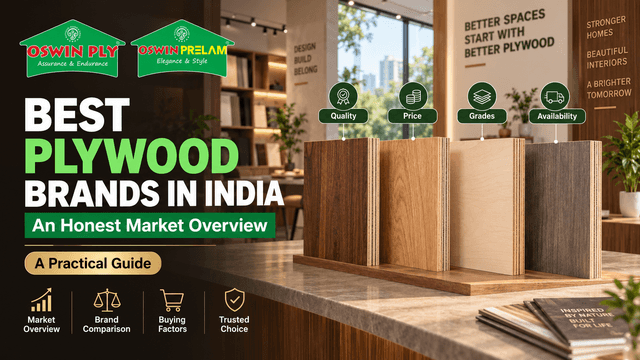
For a look at the major names, see Best Plywood Brands in India. This guide is about judging the board in front of you.
Quality plywood starts with the wood. Veneers peeled from good logs are even in thickness, free of large knots and dried to the right moisture level before gluing. Uneven or poorly dried veneers leave gaps, overlaps and weak spots inside the board.
The second factor is the glue line. The adhesive must be spread evenly and pressed with enough heat and pressure to bond every layer. A weak glue line shows up as layers peeling at the edge, bubbles on the face or a board that bends under a light load.
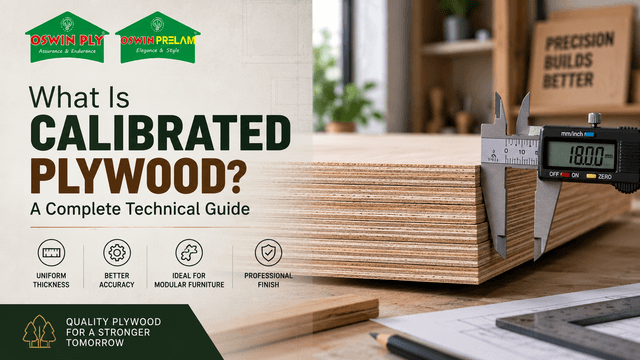
The third is consistency. A well-made board has the same thickness from edge to edge and from one sheet to the next, a tight core and clean faces. Consistency is what a good brand offers, and it is something you can check with a caliper and a careful look at the edge.
| Piece | What matters most | What to check |
|---|---|---|
| Wardrobe carcass | Stiffness and screw holding | Core tightness and thickness |
| Kitchen unit near water | Moisture grade and edges | Grade marking and sealed edges |
| Bed base | Strength across the span | Hardwood core and thickness |
| Door skin or panel | Flat, clean faces | Face quality and flatness |
| Shelves | Resistance to sagging | Thickness, span and edge |
For any large order, ask for an invoice that names the grade, the thickness, the sheet size and the brand. Ask what the dealer's return or replacement terms are, and get them in writing. Keep the sheet markings visible until the job is done, so you can show what was supplied. Buying from an authorised dealer makes all of this easier, because the brand stands behind the dealer.
Not every part of a piece needs the same board. A hidden back panel can be a thin, plain sheet. A wardrobe carcass needs a tight, stiff core. A kitchen unit near water needs the right moisture grade. A visible face needs a clean veneer or a good laminate over a sound board. Put your attention on the parts that carry load, face water or show, and accept simpler boards where they do not matter. That is a better approach than choosing the highest grade for every part.
Oswin Ply makes plywood, block board, flush doors and prelam particle board, and sells them through authorised dealers. Ask your dealer to show you the grade marking on the sheet before you buy.
There is no single best plywood. The best board is the grade that matches your job, built honestly, with the grade marked on the sheet.
Look at the cut edge for tight, even layers, measure the thickness at several points, check the faces and flatness, and read the marking on the sheet.
No. Thickness should match the load. A thinner sheet of the right grade can outperform a thicker sheet of the wrong one.
Check that the brand and grade are printed on the sheet, buy from an authorised dealer, and ask for an invoice that names the grade and thickness.
A brand helps with consistency, but you should still check the grade, thickness and edges of the sheet you are buying.
Ask for the grade and where it is marked, the adhesive, the core wood, the true thickness and the written specification.
Look for gaps and overlaps in the cut edge, thickness well under the label, loose veneer, bowing, and no clear marking on the sheet.
Yes, for a day or two on site, stored flat, so the sheets adjust to the room's humidity before they are cut.
No. Hidden parts such as back panels can use a thinner or simpler board, while load-bearing, wet-zone and visible parts need better ones.
Oswin Wood Panels manufactures ISI-certified plywood, block board, flush doors and Prelam boards from Chennai. Find your nearest Oswin Ply dealer and name the board, grade and thickness you want.
Call 044 2669 0023.
Written by Mr. Balakrishna Iyer, GM – Sales (Tamil Nadu), Oswin Ply (Oswin Wood Panels Pvt. Ltd), a Chennai-based plywood and block board manufacturer. We manufacture ISI-certified BWP plywood, marine plywood, flush doors, block boards and Prelam boards, including HDHMR-core options, supplying dealers across Tamil Nadu, Karnataka, Andhra Pradesh, Telangana, Maharashtra and Goa.